Quick answer
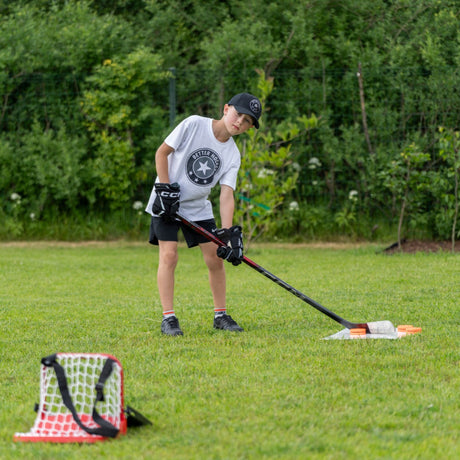
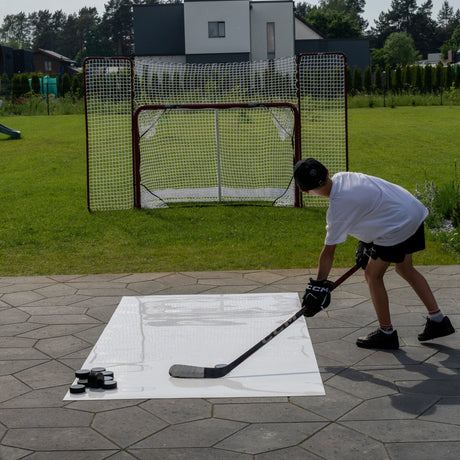
To practice hockey shooting at home you need four things: a smooth shooting surface (a shooting pad), something to shoot at (a net with corner targets), something to protect what's behind it (a tarp or backstop net), and a repeatable routine. A 4×8 ft strip of garage, basement, or driveway is enough. Run a structured 100-shot session 5–6 days a week — about 20 minutes — and track one score per session. That's the whole system.
Key takeaways
- Minimum space: about 4×8 ft plus room to swing a stick — one garage bay is plenty.
- Never shoot off bare concrete or asphalt: it wrecks blades and gives a false puck feel.
- A tarp or backstop behind the net is not optional if there's anything breakable within 25 feet.
- The 100-shot routine (warm-up, technique, power, accuracy, quick release) takes about 20 minutes.
- Track two numbers per session: accuracy hits and total shots for the week.
- Indoors, drop shot power to 70–80% and save full-power slappers for outside.
What setup do you need to shoot pucks at home?
Build it in this order — each layer adds training value:
| Priority | Item | Why | Space needed |
|---|---|---|---|
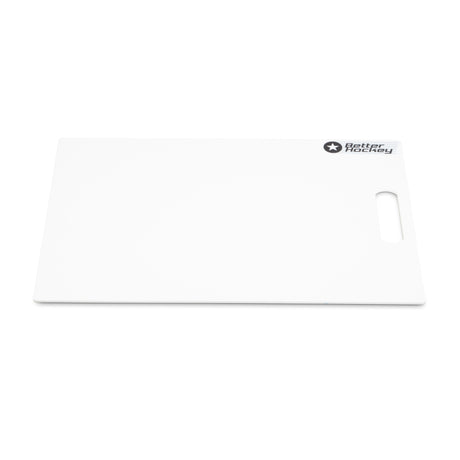
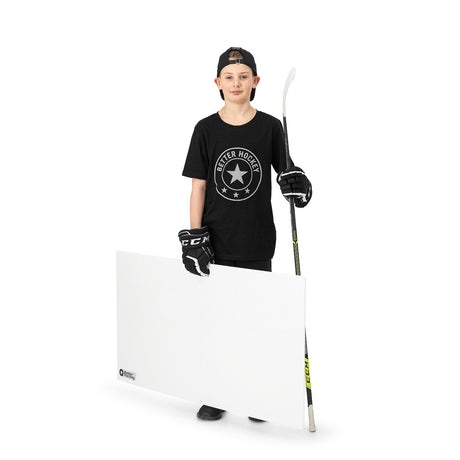
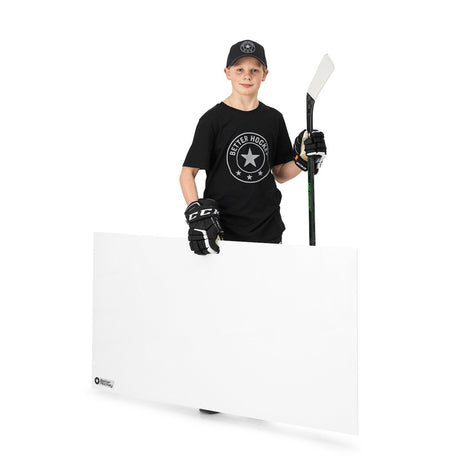
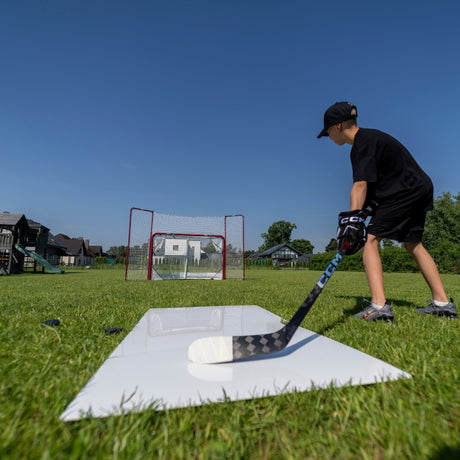
| 1 | Shooting pad (24"×48") | Ice-like glide, protects blade and floor | 4×8 ft total zone |
| 2 | Net — full-size steel goal | Real corner positions, real feedback | 6×4 ft footprint |
| 3 | Shooting tarp or backstop net | Catches misses — saves walls, windows, siding | Behind/around net |
| 4 | Corner targets | Turns shooting into aimed practice | Hangs in net |
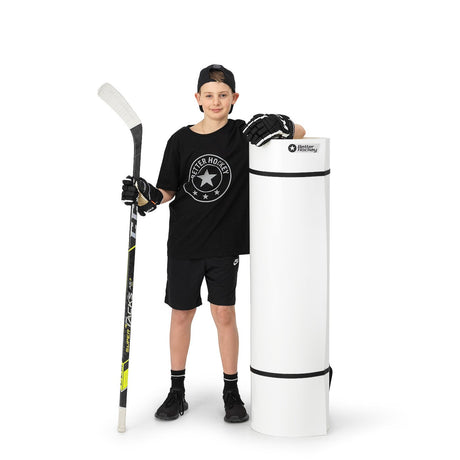
| 5 | Upgrades: roll-up pad (4'×8.5') or tiles shooting kit | Shooting in motion, permanent zone | 8×12 ft and up |
If you'd rather buy once than piece it together, a start-up shooting kit bundles the essentials. For help choosing the surface itself, see our shooting pad buyer's guide.

How much space do you need?
- Minimum (wrist and snap shots): 4×8 ft of floor plus 8 ft of ceiling height. A basement corner works.
- Comfortable (adds distance and angles): 10×15 ft — a single garage bay or driveway strip. Shoot from 10–15 feet.
- Full setup (shooting in motion, full power): 15×25 ft outdoors with a backstop. This is where slap shots and one-timers live.
Distance matters less than most players think — I run whole shooting blocks at camps from 10–20 feet, and NHL-level shooters take most of their training shots from the same range. Accuracy at close range transfers; long-range bombs off a driveway mostly don't.
The daily 100-shot routine
Twenty minutes, five blocks. Same structure every day — the variety comes from targets and shot types, not from improvising.
- Warm-up — 10 shots. Half-speed wrist shots, focus on the heel-to-toe roll and full follow-through. No target yet.
- Technique — 30 shots. Wrist shots at 70% power, alternating low glove / low blocker. Every rep from proper stance with weight transfer. Watch for: weight stuck on the back foot — with nobody watching, it's the first thing that slips. (Mechanics refresher: how to improve your wrist shot.)
- Power — 20 shots. Full-power wrist and snap shots outdoors, or 80% indoors. Optionally 10 of these with a heavy puck for wrist strength.
- Accuracy — 30 shots. Call a corner target before every shot — out loud, because silent calls turn into no calls. Count hits out of 30 — this is your session score.
- Quick release — 10 shots. Pull the puck from outside your stance and fire within one second. Cue: "one touch, gone" — and eyes up, find the corner before the puck arrives. Game speed, tired arms — exactly like a third period.
Coach Erik's tip: Don't spread the accuracy block across all four corners every day. Pick one corner and own it for a week — all 30 calls at the same target — then rotate. Players I train improve noticeably faster this way, because they finally get enough reps at one picture for it to stick.
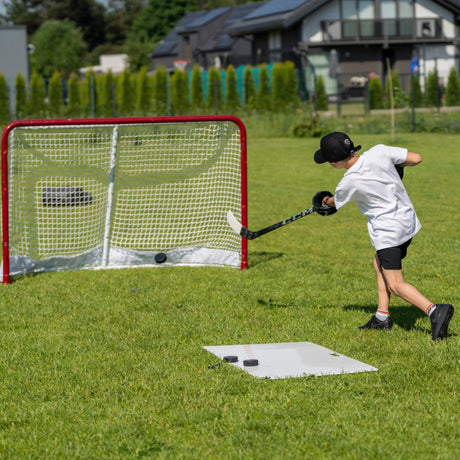
Buy pucks in bulk — a 25-pack of training pucks means you shoot 25 before collecting instead of chasing one puck around the garage. Here's the routine in action:
How to track progress
Improvement you can't see is improvement you'll quit. Keep it to two numbers and one optional gadget:
- Accuracy score: hits out of 30 from the accuracy block. Write it on a whiteboard by the net. When you average 20/30, shrink the target or add distance.
- Weekly volume: sessions × 100. Aim for 500–600 shots a week. A month of that is more shots than most players take in a season of practices.
- Shot speed (optional): a speed radar gives you an mph number to beat. Test 10 max-power shots once a week, same distance every time.
Coach Erik's tip: When you hit the 20/30 average, resist the urge to add distance first — shrink the target instead. A tighter window from 15 feet builds a sharper release than a big window from 30, and it forces the quick, precise hands games actually reward.
How do you protect walls and windows?
A missed high shot carries serious energy — treat safety as part of the setup, not an afterthought.
- Behind the net: a 7×10 ft tarp hung from the garage ceiling or fence catches everything that misses. For wide outdoor zones, a 5×25 m backstop net covers the whole flight path.
- Distance from glass: keep at least 25 feet between your shooting spot and any window that isn't screened by a tarp — deflections fly at weird angles.
- Indoors: cap power at 70–80%, use training pucks (not street balls that bounce), and check ceiling clearance for your backswing.
- Kids nearby: one shooter at a time, everyone else behind the shooter, never behind the net.
Common mistakes
- Shooting off bare concrete. Blades fray in weeks and the puck drags. Fix: pad or tiles, always.
- No backstop "just this once." That's the session a window dies. Fix: hang the tarp before the first puck.
- All power, no aim. 100 unaimed rockets build nothing. Fix: 30 of every 100 shots are called-target accuracy reps.
- Setup friction. If it takes 15 minutes to set up, you'll skip days — this quietly ends more home training than anything else I see. Fix: leave the zone permanently assembled, pucks stacked on the pad.
- Never changing the challenge. Same shot from the same spot plateaus in weeks. Fix: rotate angles, distances, and targets weekly — the shooting drills library has a season's worth.
FAQ
Can I practice shooting in an apartment?
Stickhandling yes, full shooting no. In an apartment, train stickhandling with a ball, do slow-motion technique reps into a cushion, and save real shooting for a driveway or outdoor rink. The noise and puck energy aren't neighbor-compatible.
What surface should I shoot from at home?
A dedicated shooting pad is the standard: smooth enough for ice-like puck glide, tough enough to protect your blade and the floor. For a permanent zone, interlocking training tiles create a larger rink-feel surface you can also skate drills on in shoes.
How many pucks do I need?
15–25. Enough to shoot a full block before collecting, which keeps the session moving. Training pucks in bulk packs are the economical route, plus a few heavy pucks for strength work from age 10 up.
Is it OK to shoot a puck at a regular soccer or street hockey net?
A real puck at full power will destroy light nets and their netting fast. Use a steel hockey goal with proper netting — it also gives you true corner dimensions, so your aiming practice transfers to games.
How long until home shooting practice shows up in games?
Most players notice a harder, quicker release within 4–6 weeks of consistent 100-shot sessions. Coaches usually spot the difference in shot confidence — players who shoot 500+ pucks a week stop hesitating in scoring positions.
Should I practice shooting every day?
5–6 days a week is the sweet spot; one rest day helps wrists and hands recover. If you're also doing team practices, 4 home sessions a week still adds roughly 400 extra shots most teammates aren't taking.
Summary
A home shooting setup is a one-time, one-afternoon project: pad, net, tarp, targets, pucks stacked and ready. From there it's the 100-shot routine — warm-up, technique, power, accuracy, quick release — five or six days a week, with an accuracy score written down after every session. Small space, small time cost, and in a month you've taken 2,000+ deliberate shots.
Related guides: hockey training at home for the full multi-skill system, the best shooting pad guide for choosing your surface, and the shooting library for what to train once you're set up.