Quick answer
A quick release means getting your shot away in under half a second from the moment the puck hits your blade — before the goalie is set. Train it by removing the wind-up: shoot off the pass in one motion, keep your hands away from your body, and snap the puck with wrists and body lean instead of a big pull-back. The core workout is catch-and-shoot repetitions off a passer or rebounder — 50 per day builds a release that beats goalies who would stop your hardest wind-up shot.
Key takeaways
- Goalies stop shots they can read. A modest shot released in 0.3 seconds beats a bomb released in 0.9.
- The quick release is one motion: catch and shoot, never catch–stickhandle–aim–shoot.
- You need incoming pucks to train it — a passer or rebounder replaces a training partner.
- 50 catch-and-shoot reps a day, 5 days a week, rewires the habit in about 4 weeks.
- In-stride shooting — releasing without breaking your rhythm — is what separates scorers at higher levels.
- Change the release point every few reps; predictability is what goalies feed on.
Why release speed beats raw power
Do the goalie's math. A shot from the slot, 6 metres out, at 90 km/h reaches the goal line in about 0.24 seconds. An average goalie needs 0.4–0.5 seconds to read the release, pick a save selection, and move. If your release takes 0.8 seconds — a big pull-back, a look at the corner — the goalie has finished reading you before the puck leaves the blade. The save looks spectacular; it was actually routine.
Now flip it: the puck arrives on your blade and leaves in 0.3 seconds with no wind-up. The goalie is still tracking the pass. Even at 70 km/h, that puck crosses the line before the save selection happens. This is why NHL shooting has changed in the last decade — shot totals from the slot are down, but shooting percentage off quick catch-and-release is up. Modern scorers hide the shot, they don't load it. I tell every player I coach: your goal is not to beat the goalie with speed, it is to beat them before they know you have the puck.
Raw power still matters — from distance, on one-timers, through traffic — and you should train it too (see How to Shoot Harder in Hockey). But given the choice, train the release first. It scores from the areas where goals actually happen.
What makes a release quick?
Four mechanical habits, all trainable off-ice:
- No wind-up. The puck goes from reception to release in one continuous motion. Every extra touch is 0.2 seconds of goalie reading time. Cue: "one motion, not two" — if you can hear a pause between the catch and the shot, add a rep.
- Hands away from the body. Keep the puck at arm's length with the blade already behind it. Cradled close to your feet, the puck needs repositioning before it can leave.
- Weight already loaded. Receive the pass with knees bent and weight on the shooting-side leg, so the "transfer" already happened. The shot borrows power that is pre-loaded. Watch for: standing tall while waiting for the pass — you then have to bend and load, adding a half-second the goalie uses to read you.
- Wrist snap over arm sweep. The quick release is 70% wrists: blade closes over the puck and snaps it out. Less speed than a full wrist shot, far less warning.
Catch-and-shoot mechanics, step by step
- Set up facing the passer with your blade on the surface as a target, knees bent, top hand away from your body.
- Receive the puck slightly behind your shooting position — on the back third of the blade — with soft hands, letting the blade give a few centimetres. Cue: "give with the blade" — a rigid hand bounces the puck; a soft hand absorbs it into the shot.
- Let the pass's own momentum carry the puck into your shooting pocket. Do not stop the puck. A stopped puck is a reset; a moving puck is a loaded spring.
- As the puck rolls toe-ward, lean onto the shaft and snap the wrists. The catch flows into the shot as one motion. Cue: "ride the pass into the shot" — the puck's momentum is free power; use it.
- Follow through low and at the target — a quick release aims with the blade, not with a long follow-through.
Coach Erik's tip: The most common mistake I see in catch-and-shoot training is players catching the puck dead and then starting their shot — two movements instead of one. I fix this with a simple constraint: if the puck stops moving on your blade for even a moment before the shot, the rep doesn't count. It sounds harsh, but after ten reps your hands learn to ride the pass instead of killing it, and the improvement in timing is immediate.
How do you train quick release without a partner?
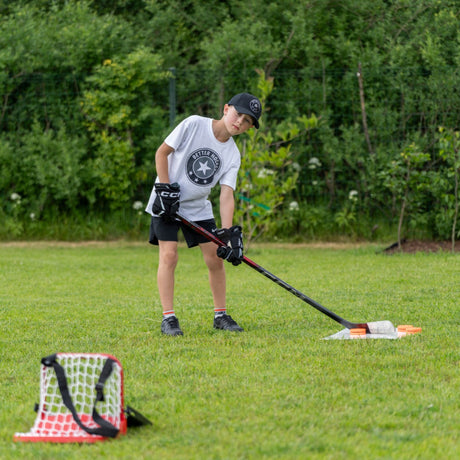
You need pucks arriving on your blade, over and over. Two tools solve it:
- A passer feeds you clean, flat passes on demand — the closest thing to a teammate who never gets bored.
- A rebounder returns your own pass at game speed and lets you control the tempo: pass, catch, shoot, repeat.

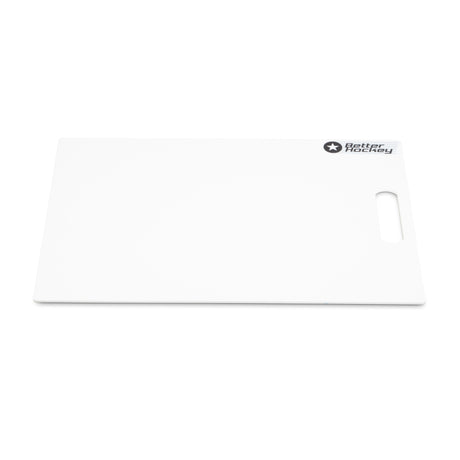
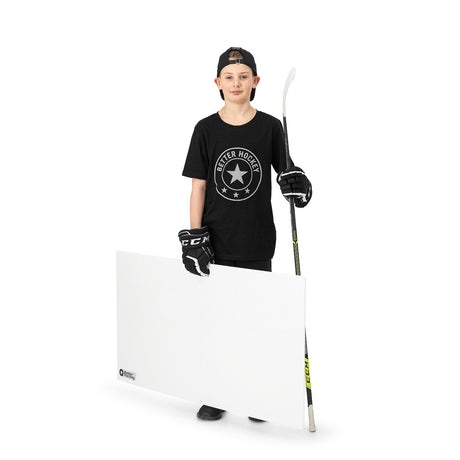
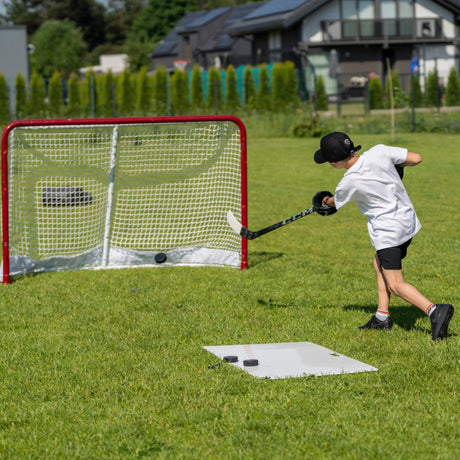
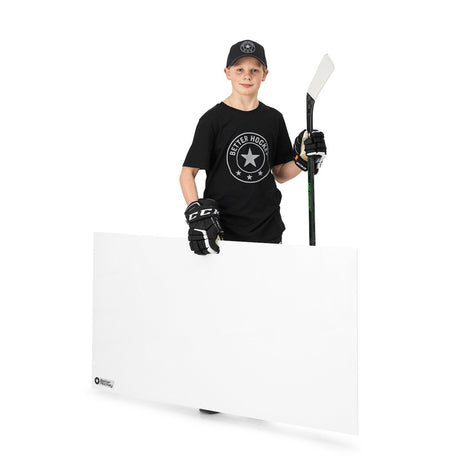
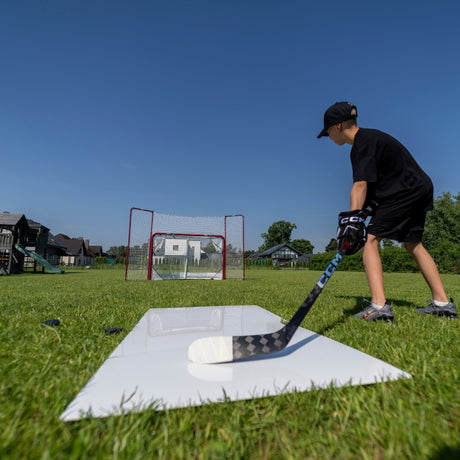
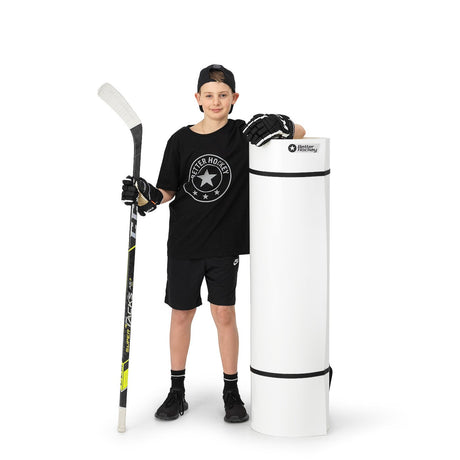
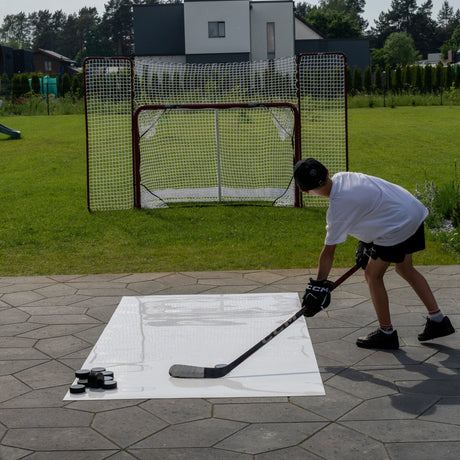
Set up on a smooth surface big enough to receive and shoot in one motion — a pro shooting pad is the minimum, and flooring tiles give you room to shoot in stride. Add shooting targets in the net so every rep has an address.
Here is the catch-and-shoot setup in action:
The quick release workout: 5 drills, 20 minutes
- One-touch snaps — 20 reps. Puck stationary at your side. Pull it into the pocket and release in one motion. No settling, no aiming pause. Goal: under 0.5 seconds from first touch.
- Catch-and-shoot — 3 sets of 10. Pass off the rebounder or passer, receive, release as one motion. Alternate the target corner each set: low glove, low blocker, high glove.
- Bad-pass cleanup — 15 reps. Angle the rebounder so returns arrive in your feet or behind you. One touch to fix, immediate release. Games rarely give you perfect passes.
- In-stride release — 2 sets of 10. Walk or shuffle across the surface stickhandling, then release mid-stride without stopping your feet or breaking rhythm. The shot should hide inside your movement pattern.
- One-timers — 2 sets of 8. Blade set behind the incoming pass, weight loaded on the back leg, meet the puck with a short compact swing — half the backswing you think you need. Timing beats force: hit it clean at 60% and add power over weeks.
Total: about 100 release reps. Run it 5 days a week and log how many of your catch-and-shoot reps hit the called target.
Coach Erik's tip: Add a small constraint to the in-stride drill to sharpen heads-up awareness: have a partner hold up a number of fingers as you're stickhandling, and you call it out just before you shoot. It forces your eyes up and your brain to process two things at once — exactly what happens in a game when you're reading the goalie's positioning while controlling the puck. Most players I run this with are surprised how much their release sharpens when their eyes are on the target instead of the blade.
4-week quick release progression
| Week | Focus | Daily volume | Success marker |
|---|---|---|---|
| 1 | Clean catch, one-motion release, easy tempo | 50 reps | No double-touches on 8 of 10 reps |
| 2 | Full workout, called targets | 75 reps | 5 of 10 on target per set |
| 3 | Speed: faster feeds, bad-pass drill added | 100 reps | Release under 0.5 s even on bad feeds |
| 4 | In-stride and one-timers emphasized | 100 reps | 7 of 10 on target, feet never stop |
Common mistakes
- Catching, then shooting. Two motions with a pause between them. Fix: think of the pass as the start of your shot, not something that precedes it.
- Stopping the puck dead on reception. Kills the free momentum. Fix: soft hands, let the puck keep rolling toe-ward into the release.
- Standing tall waiting for the pass. Then you must bend before shooting. Fix: knees bent and weight loaded before the puck arrives.
- Full wind-up on one-timers. Big swings mistime fast feeds. Fix: half backswing, meet the puck, let the pass supply the power.
- Same release point every rep. You are training the goalie. Fix: change angle, distance, and target every few reps.
- Only training with perfect passes. Games deliver garbage. Fix: bad-pass cleanup drill, every session.
FAQ
What is a quick release in hockey?
A quick release is the ability to shoot within roughly half a second of the puck reaching your blade, with no wind-up or extra touches. It beats goalies by taking away their reading time — the puck is in the net before the save selection happens.
Is a quick release better than a hard shot?
From scoring areas, yes. From the slot, a goalie needs 0.4–0.5 seconds to react, so a shot released in 0.3 seconds scores even at moderate speed, while a slow-loading bomb gets read and stopped. The best shooters train both, but release wins where most goals happen.
How do I get a quicker release?
Remove the wind-up: receive and release in one motion. Train 50–100 catch-and-shoot reps daily off a passer or rebounder, keep your hands away from your body, and load your weight before the puck arrives. Most players feel a clear difference in about 4 weeks.
Can I train quick release alone?
Yes. A rebounder returns your passes at game speed, and a passer feeds you flat pucks on demand — both replace a training partner. Add a smooth shooting surface and net targets and you can run a complete catch-and-shoot session solo in 20 minutes.
How do you shoot in stride?
Release the puck without stopping your feet or changing rhythm, hiding the shot inside your normal movement. Off-ice, practice stickhandling across your surface and snapping shots mid-stride. The goalie reads footwork and body cues — take those away and an ordinary shot becomes hard to stop.
How many reps does it take to improve a one-timer?
Around 15–20 one-timer reps per session, 4–5 days a week, with a compact half-backswing at controlled power. Timing is the skill: hit the puck clean at 60% effort first, then add power over 3–4 weeks as contact becomes automatic.
Summary
Modern goalies are too good to beat with power they can see coming — so hide the shot. Catch and release in one motion, hands away from the body, weight pre-loaded, wrists doing the work. Run the 5-drill workout daily off a passer or rebounder, follow the 4-week progression, and track your on-target percentage. In a month, coaches will notice pucks going in that used to end up in the goalie's glove.
Pair this with How to Shoot Harder in Hockey for the power side, sharpen your feeds with passing accuracy drills, or see the whole system in the Ultimate Off-Ice Training Guide and the shooting library.