Quick answer
Off-ice hockey training is structured practice away from the rink that builds the six things every player needs: shooting, stickhandling, passing, strength, speed, and conditioning. Done 4–6 days a week in sessions of 20–45 minutes, it produces more skill repetitions in a month than most players get in a full season of team practices. All you need is a flat space of about 4×8 feet, a shooting surface, a stick, pucks or balls — and a plan, which this guide gives you.
Key takeaways
- Ice time is for using skills; off-ice time is for building them. A player who takes 100 shots a day at home out-shoots a teammate who only shoots at practice by roughly 30,000 shots a year.
- Complete off-ice training covers six pillars: shooting, stickhandling, passing, strength, speed/agility, and conditioning.
- Under age 10, off-ice training should look like play: games, targets, competitions, 15 minutes at a time.
- Off-season is for building (strength, mechanics, volume); in-season is for maintaining (short skill sessions, low fatigue).
- A starter setup — shooting pad, ball, pucks — costs less than two hours of private ice and lasts for years.
- Track your numbers. Shots per week, minutes of stickhandling, slide board sets — what gets counted gets better.
Why off-ice training matters
Do the math on a typical season. A youth player gets two or three team practices a week. In each one, the puck is on their stick for less than 60 seconds, and they might take 15–20 shots. That is not enough repetition to change a skill — it is barely enough to keep one.
Skills are built by volume: thousands of correct repetitions of the same movement. The only place that volume is realistic is off the ice, where reps are free and nobody is waiting in line behind you. This is why every serious development program — including the Swedish model that Better Hockey grew up around — treats off-ice work as a core part of training, not an optional extra.
There is a second reason: athleticism. Skating power, shot power, and balance in battles come from strength and explosiveness that are trained far more effectively in a garage or backyard than in skates. The players who separate themselves at 15 and 16 are almost always the ones who trained their bodies off the ice from 11 or 12.
If you are brand new to training at home, start with our practical setup guide: Hockey Training at Home. This article goes deeper: what to train, how much of it, at what age, and at what time of year.
The six pillars of off-ice hockey training
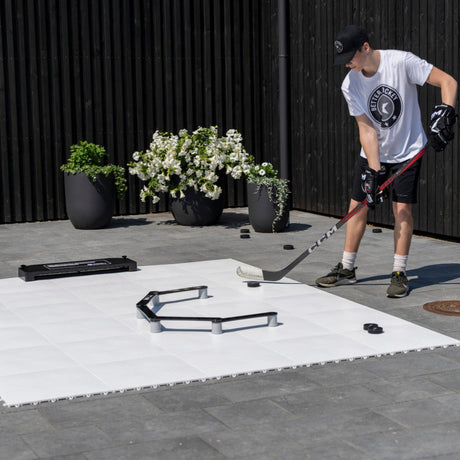
Here is what complete off-ice training looks like in action:
1. Shooting
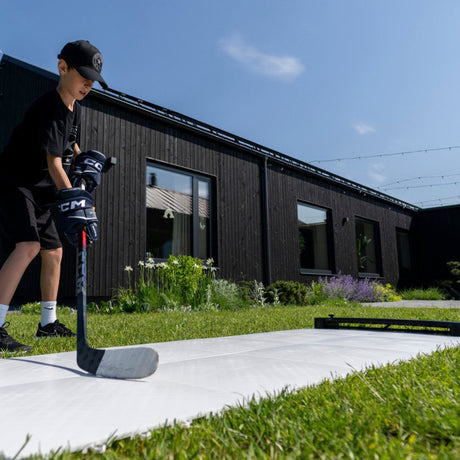
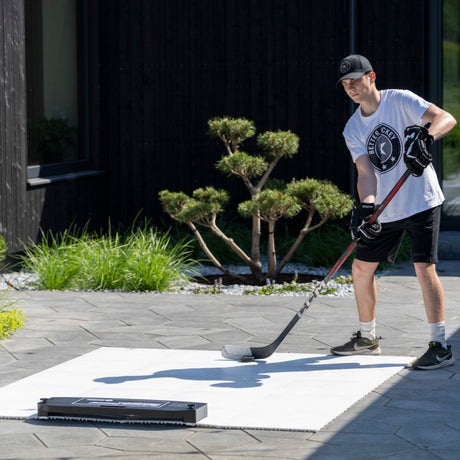
The most trainable skill in hockey. Shot power and accuracy respond directly to volume: 100 shots a day, five days a week, with a target for every puck. Work wrist shots (50), snap shots (25), and accuracy rounds (25) where you call the corner before you shoot. Cue: finish with the blade pointing at your target — it forces a full follow-through. Always shoot from a smooth surface — a shooting pad gives the puck ice-like glide and saves your blade. If you have room for a full shooting station, a 4×8.5 ft roll-up pad lets you shoot in stride, not just standing still.
Deep dives: How to Improve Your Wrist Shot and the rest of the shooting library.
How much is enough? A useful benchmark ladder: a 10-year-old taking 300 shots a week is developing fast; a 13-year-old should be at 400–500; a serious 16-year-old shoots 500–700 a week in the off-season. Spread across five or six days, none of those numbers takes more than 25 minutes a day.
Coach Erik's tip: Before you chase weekly shot counts, film ten shots from the side. The error I see constantly is the puck starting too close to the feet — drag it back and away from your body so the stick can actually load. Fix that first, and every rep after it counts double.
2. Stickhandling
The best value per square foot — quick hands are trained in a doormat-sized space. The daily dose is 10 minutes: 4 minutes of basic dribbles (narrow and wide), 3 minutes around obstacles, 3 minutes of toe drags and fakes. Cue: the top hand does the rolling, the bottom hand just steers. Use a stickhandling ball on bare floor or a puck on a pad, and keep your head up from rep one — a partner flashing fingers for you to count is the simplest scanning habit I know. A stickhandling trainer adds obstacles that force you to move the puck around a "defender's stick" instead of just side to side.
Full technique breakdown: How to Improve Stickhandling.
3. Passing
The most neglected pillar, because players assume they need a partner. They don't — a rebounder fires the puck back to your blade, so you can train 50 crisp passes and 25 one-touch receptions alone in under 10 minutes. Firm passes, soft hands on the return, both forehand and backhand. Watch for: stabbing at the return — let the blade give a few centimeters and cushion the puck. Add saucer passes over an obstacle once flat passes are automatic.
Drills with reps and targets: Hockey Passing Accuracy Drills.
4. Strength
Hockey strength lives in the legs, hips, and core. Off the ice, bodyweight work covers most players until about age 14: squats, split squats, lunges, hip bridges, push-ups, and planks. A basic session is 3 rounds of 10–12 reps per exercise, twice a week. From 14–15 up, loaded strength work (goblet squats, trap bar deadlifts, weighted carries) becomes the biggest single driver of skating speed and shot power. Strong wrists and forearms — trained with simple stick lifts and wrist rollers — put the finishing touch on your shot.
Two rules keep strength training productive and safe. First, technique before load: a young player earns the right to add weight by doing 12 perfect bodyweight reps first. Second, legs get double the attention of everything else — hockey is played from the waist down, and no amount of bench pressing wins a puck battle that your legs lose.
Coach Erik's tip: Players I train always want to add weight months before their single-leg work is ready. My rule: own ten slow split squats per leg without a wobble before anything heavy goes on your back. Skating is a one-leg sport — the barbell can wait.
5. Speed and agility
Skating fast starts with sprinting fast. Short off-ice sprints (10–20 m), lateral bounds, and quick-feet ladder or cone patterns train the explosive first three steps that decide most races to the puck. Keep it crisp: 6–10 sprints with full rest beats 20 tired ones. Resistance sprinting with a speed chute adds load to acceleration without changing your running mechanics.
6. Conditioning
Hockey is a sprint sport played in 40-second shifts, so condition like it: intervals, not jogging. The single best off-ice conditioning tool is a slide board, because it loads the exact lateral stride pattern of skating — 30–45 seconds of hard slides, 4–8 sets, mirrors a period of shifts. Bikes and hill sprints work too; long slow runs do the least for hockey players.
What equipment do you need for off-ice training?
You can start with almost nothing and build over time. Honest priorities:
| Priority | Equipment | Trains | Space needed |
|---|---|---|---|
| Start here | Shooting pad, stickhandling balls, pucks | Shooting, stickhandling | 4×8 ft |
| Add next | Rebounder, targets, net | Passing, accuracy, one-timers | 8×12 ft |
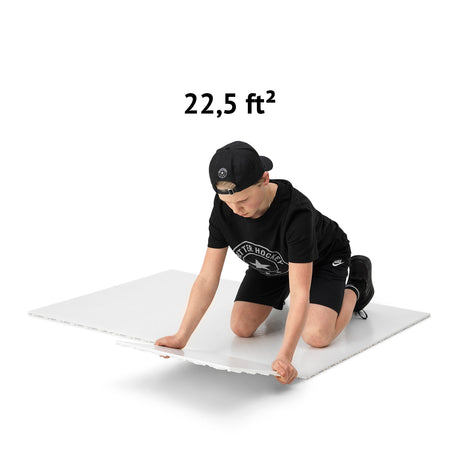
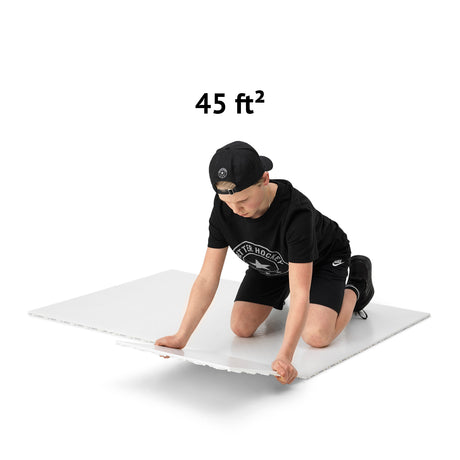
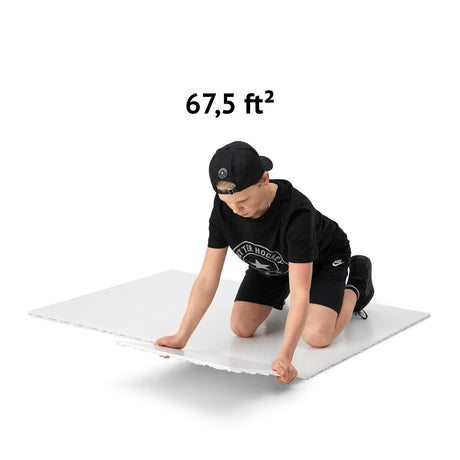
| Level up | Flooring tiles, roll-up pad | Everything in stride, full setups | 10×15 ft+ |
| Athletics | Slide board, speed chute | Conditioning, skating power, speed | Hallway / yard |

None of it is mandatory on day one. A stick, a ball, and a smooth patch of floor already cover two pillars. Add pieces when your current setup is the thing holding you back — not before.
How does off-ice training change with age?
The biggest mistake I see in youth training is giving a 9-year-old a 16-year-old's program. Match the work to the age:
| Age | Session length | Focus | What to avoid |
|---|---|---|---|
| 5–9 | 10–15 min | Games and challenges: knock-down targets, obstacle dribbles, mini competitions | Structured programs, rep counting, any loaded strength work |
| 10–13 | 20–30 min | Skill volume: shooting and stickhandling routines, bodyweight strength, short sprints | Heavy weights, long conditioning sessions |
| 14–17 | 30–60 min | All six pillars; introduce loaded strength training and slide board intervals | Skipping strength basics to only shoot pucks |
| 18+ | 45–75 min | Periodized strength and conditioning plus daily skill maintenance | Random training with no seasonal plan |
The through-line: skills every year from the start, athleticism layered on top as the body matures. If a session stops being fun for a young kid, it stopped being productive five minutes earlier.
How should you train across the season?
Off-ice training is not the same in July as in January. Split the year into three blocks:
| Phase | When | Priority | Weekly pattern |
|---|---|---|---|
| Off-season | May–Aug | Build: strength, speed, shot mechanics, big skill volume | 5–6 days: 3 strength/speed + daily 30 min skills |
| In-season | Sep–Mar | Maintain: short skill sessions, 1–2 strength sessions, stay fresh for games | 3–4 days: 15–25 min skills + 1–2 short strength sessions |
| Post-season | Apr | Recover: rest, other sports, free play | Unstructured — touch a stick when you feel like it |
The off-season is where players are made. With no games to recover for, you can train hard 5–6 days a week and rebuild your shot from the mechanics up. A good off-season builds in waves: three weeks of increasing volume, then one easier week to absorb it, repeated across the summer. In-season, the goal flips: keep your hands and shot sharp with short sessions that never leave you tired for tomorrow's game. Never do a hard conditioning session the day before a game; put it on the day after instead.
Coach Erik's tip: In-season I give players one non-negotiable: never finish a home session tired. If your legs feel heavy for tomorrow's practice, the session was too long — ten sharp minutes beats thirty sloppy ones from October to March.
The April break matters more than most families think. Four weeks of other sports, free play, and no counted reps is not lost development time — it is what lets a player come back hungry in May instead of burned out at 14. The players still improving at 17 are almost never the ones who trained twelve months a year at 11.
Sample off-ice training programs
Three ready-to-run templates. Pick the one that matches your season and experience, run it for four weeks, then adjust.
Starter program (any age, 3 days/week)
- Day 1 — Shooting: 50 wrist shots, 25 snap shots, 25 called-target shots. 20 minutes.
- Day 2 — Hands and passing: 10 minutes stickhandling (dribbles, obstacles, toe drags) + 50 passes off a rebounder. 20 minutes.
- Day 3 — Athlete day: 3 rounds of 10 squats, 10 lunges per leg, 10 push-ups, 30-second plank; finish with 6×10 m sprints. 20 minutes.
In-season maintenance (4 days/week, 15–25 min)
- Day 1: 75 shots with targets.
- Day 2: 10 min stickhandling + 25 one-touch passes per side.
- Day 3: Strength circuit, 2–3 rounds, moderate effort.
- Day 4 (day after game): Slide board or bike intervals, 6×30 seconds.
Off-season build (5–6 days/week)
- Mon — Strength: squats, split squats, hip bridges, core; 3–4 sets of 8–12.
- Tue — Skills: 100 shots + 10 min stickhandling.
- Wed — Speed: 8 short sprints (chute optional) + lateral bounds 3×8.
- Thu — Skills: 50 passes, 25 one-timers, 10 min hands.
- Fri — Strength: repeat Monday with small progressions.
- Sat — Conditioning: slide board 6–8×40 seconds; Sun off.
Want this laid out day by day with exact sets, reps, and scaling for beginners and advanced players? Use our complete Weekly Off-Ice Hockey Program — it is the ready-made version of everything in this guide.
How do you track off-ice progress?
Training without measurement is guessing. You don't need an app or a spreadsheet — a notebook and a monthly self-test do the job. Log three things after each session (what you trained, key numbers, one note), then run this test on the first weekend of every month:
| Test | Protocol | What improving looks like |
|---|---|---|
| Shot accuracy | 20 shots, call the corner before each | +2–3 hits per month |
| Shot speed (optional) | 10 shots at a fixed distance, radar, log best 3 | +2–4 km/h per month early on |
| Hands under pressure | Figure-eight around two obstacles, 30 seconds, count clean circuits | +1–2 circuits per month |
| Passing touch | 20 one-touch passes off the rebounder, count clean receptions | 18+ within three months |
| Engine | Max slide board (or skater jump) seconds at hard effort before form breaks | +10–15 seconds per month |
Two warnings from years of running these tests with players. Progress is never linear — expect a flat month somewhere, keep training, and judge the trend over a season. And test in the same conditions every time: same surface, same distance, same rested state, or the numbers mean nothing.
Common mistakes
- Only training the fun pillar. Everyone shoots; few train passing or legs. Fix: follow a written weekly plan that touches all six pillars.
- Shooting off concrete. Ruins blades and teaches a false puck feel. Fix: always shoot from a pad or tiles.
- Marathon weekend sessions. Two hours on Sunday loses to 25 minutes daily. Fix: schedule short sessions like brushing your teeth.
- Adult programs for kids. A 9-year-old doing interval conditioning is wasted time. Fix: games and challenges until about age 10.
- Training hard the day before games in season. Fix: hard sessions go the day after a game, light skills the day before.
- No tracking. If you don't count shots, minutes, and sets, you can't see progress. Fix: a notebook or notes app — 30 seconds after each session.
FAQ
What is off-ice hockey training?
Off-ice training is any structured hockey practice done away from the rink: shooting, stickhandling, and passing repetitions, plus strength, speed, and conditioning work. It exists because ice time gives players too few repetitions to actually build skills — off-ice work supplies the volume.
How many days a week should a hockey player train off the ice?
In the off-season, 5–6 days a week with a mix of skills and athletic work. In-season, 3–4 short sessions of 15–25 minutes that keep skills sharp without adding fatigue before games. Even 3 days a week, done year-round, puts a player far ahead of teammates who only attend practice.
Can off-ice training replace ice time?
No — skating, game reading, and battles need ice. But off-ice training multiplies your ice time: players who build their shot and hands at home use practices and games to apply skills instead of learning them. The best development plan is ice time plus daily off-ice work, not one or the other.
What equipment should I buy first for off-ice training?
A shooting pad, a stickhandling ball, and a handful of pucks — together they cover shooting and stickhandling for less than the cost of two hours of private ice. Add a rebounder for passing next, then targets, a net, and eventually flooring tiles for a permanent home zone.
At what age should hockey players start off-ice training?
From age 5–6 as play: knock-down targets, obstacle dribbles, and mini competitions in 10–15 minute doses. Structured routines with counted reps make sense from about age 10, and loaded strength training from about age 14–15 with good supervision.
How long until off-ice training shows results on the ice?
Most players feel a difference in 3–4 weeks of consistent daily work — the puck sits quieter on the blade and shots come off harder. Visible differences in games (quicker release, winning more pucks) typically show within one season of 4–6 sessions per week.
Summary
Off-ice hockey training is where players are actually built: six pillars — shooting, stickhandling, passing, strength, speed, and conditioning — trained in short, frequent sessions that fit in a garage or backyard. Match the work to your age, build hard in the off-season, maintain in-season, and count your reps. Start with the starter program above this week; in a month you will feel it on the ice.
Next steps: set up your space with Hockey Training at Home, follow the day-by-day Weekly Off-Ice Hockey Program, and browse the full off-ice training library for deep dives on every pillar.