Quick answer
To improve stickhandling, practice 10 minutes a day with soft hands, control coming from your top hand, and your head up. Start with a wooden stickhandling ball on a smooth floor, progress to a puck on a pad or tiles, and add obstacles once basic moves feel automatic. Players who do this daily see a clear difference on the ice within 3–4 weeks — faster hands, wider reach, and the confidence to make moves without staring at the puck.
Key takeaways
- Top-hand control is the foundation: your top hand steers the blade, the bottom hand just guides.
- Soft hands come from a loose grip — squeeze at 4–5 out of 10, not a death grip.
- Train heads-up from day one; hands that only work while you watch them are useless in a game.
- Progress ball → puck → obstacles → speed, in that order.
- 10 focused minutes a day beats an hour once a week.
- Track one number per week (e.g., figure-eights in 60 seconds) so you can see progress.
What makes a good stickhandler?
Watch any elite player and you'll see three things: a loose grip, a blade that stays close to the ball or puck, and eyes that scan the ice instead of the puck. None of that is talent — all three are trainable habits.
Soft hands
Soft hands means the blade cushions the puck instead of slapping it. Grip the stick at about 4–5 out of 10 pressure — firm enough that the stick doesn't twist, loose enough that your wrists can roll freely. If your knuckles are white or your forearms burn after two minutes, you're squeezing too hard. Most players I train squeeze harder the moment they speed up — so every time you add pace, check the grip again.
Top-hand control
Your top hand does 70–80% of the work. It rolls the blade over the puck (cupping it on both forehand and backhand) and steers every move. The bottom hand stays relaxed and slides along the shaft as a guide. A quick test: stickhandle with your top hand only for 30 seconds. If the ball gets away instantly, that's the gap to close — one-hand work is drill #1 below.
Coach Erik's tip: The first thing I check with a new player is the bottom hand. If it's clamped on the shaft, the top hand never learns to steer. Take the bottom hand off completely for one set — most players are surprised how much cleaner the ball moves when the top hand is forced to do the job.
Head up
In a game you have less than a second to find a pass or spot a defender. If your eyes are locked on the puck, that second is gone. Train with your eyes on a wall, a TV, or a target from the first session. It feels worse at first — your control drops maybe 30% — but that's exactly the adaptation you're building: feeling the puck instead of watching it. If you have a partner, add a scanning habit: they hold up fingers at random and you call out the count while you dribble — eyes up, hands on feel.
Ball or puck: which should you practice with?
Both, in a progression. A ball rolls fast and punishes lazy hands; a puck slides flat and matches game feel. Here's when to use what:
| Tool | Surface | Best for | When to use |
|---|---|---|---|
| Wooden stickhandling ball | Any smooth floor | Quick hands, soft touch, quiet indoor training | Daily, from day one |
| Weighted training ball | Smooth floor or pad | Wrist and forearm strength | 2–3 sessions per week once basics are solid |
| Puck | Shooting pad or tiles | Game-realistic feel, blade control | Every session where you have a surface |
| Puck with obstacles | Pad or tiles | Reach, toe drags, dekes under pressure | After 2–3 weeks of consistent basics |
A wooden stickhandling ball is the cheapest, most-used training tool in hockey — it works on any bare floor and is quiet enough for an apartment. For puck work, a shooting pad or training tiles give near-ice glide. If you want game-weight feel with ball behavior, the Game Changer stickhandling ball bridges the two.
The daily 10-minute stickhandling routine
This is the whole program. Same order every day, six days a week. All you need is a stick, a ball, and a doormat-sized patch of floor.
- Warm-up dribble — 2 minutes. Narrow, fast dribbles in front of you (width of the blade), then wide side-to-side using your full reach. Loose grip, head up for the second minute. Cue: "push-pull, not sweep" — the blade rolls over the ball on every touch.
- One-hand control — 2 minutes. Top hand only. 60 seconds of narrow dribble, 60 seconds moving the ball in a wide arc from forehand to backhand. This builds the top-hand steering that everything else depends on.
- Figure-eights — 2 minutes. Two objects (pucks, cones, or shoes) about 60 cm / 2 ft apart. Weave the ball around them in an eight. Last 30 seconds: eyes up, count ceiling tiles or watch TV.
- Toe drags — 2 minutes. Push the ball out, reach, pull it back with the toe of the blade. 10 slow perfect reps, then 10 at speed, alternating sides. Watch for: standing up on the reach — stay in your stance.
- Move of the week — 2 minutes. Pick one: fake shot to backhand pull, between-the-legs, or a one-touch deke sequence. Work the same move all week until it's automatic.
Here's what the routine looks like in practice:
How do you train stickhandling with obstacles?

Obstacles are what turn clean, comfortable hands into game hands. A defender's stick forces you to move the puck around something at full reach — so your training should too.
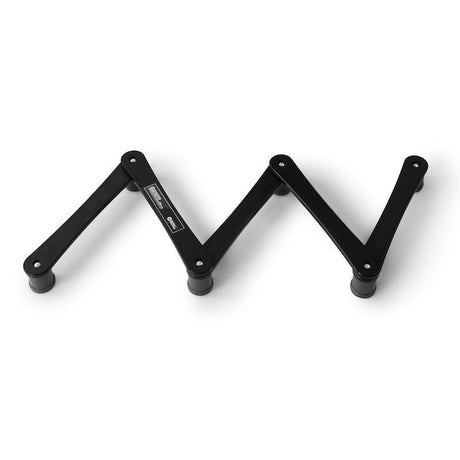
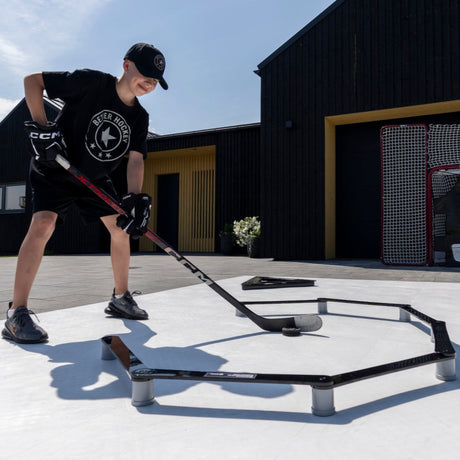
A stickhandling trainer is a folding frame of angled bars you weave the puck under and around. Because the bars sit at stick-blade height, you can't cheat: every rep forces full extension, quick escapes, and puck protection angles. Set it up three ways:
- Zig-zag line: weave the puck through the openings end to end, 10 passes through. Focus on smooth, not fast.
- Circle around it: orbit the trainer while keeping the puck moving under the bars, 60 seconds each direction.
- Escape reps: stickhandle in place, then explode the puck under a bar and out the other side — like escaping a poke check. 10 reps each side.
Coach Erik's tip: When the weave gets comfortable, don't just go faster — shrink the space. Use half the openings, or stand a stick-length closer to the bars. Tight space forces quicker hands the same way a defender does, and I've seen more improvement from that one constraint than from any new drill.
If you train on a larger surface, the Stickhandling Trainer Pro adds more bars for longer weave patterns, and a Pro Defender simulates an actual defender's stick and triangle you can toe-drag through. Start with 4 minutes of obstacle work per session, twice a week, added on top of the 10-minute routine.
How do you measure stickhandling progress?
What gets measured improves. Pick two of these tests, run them every Sunday, and write the numbers down:
- Figure-eight count: how many full figure-eights around two cones in 60 seconds without losing the ball. Beginners: 8–12. Good: 15–20.
- Heads-up test: stickhandle for 60 seconds reading a text on the wall out loud. Count how many times you look down or lose the ball. Goal: zero.
- One-hand minute: 60 seconds of top-hand-only dribbling. Count losses of control. Goal: under 3.
- Trainer weave time: time 5 clean end-to-end passes through the stickhandling trainer. Beat last week's time.
Expect noticeable improvement in 3–4 weeks of daily work, and a real on-ice difference — hands you don't have to think about — in 8–10 weeks.
Common mistakes
- Gripping too tight. Tension kills feel. Fix: check your grip every drill — 4–5 out of 10, wrists loose.
- Staring at the ball. Comfortable, and useless in games — I see it every week at camps. Fix: eyes up for at least half of every drill, from week one.
- Only fast, never clean. Sloppy speed builds sloppy habits. Fix: 10 slow perfect reps before every fast set.
- Standing tall. Straight legs shrink your reach and balance. Fix: hockey stance — knees bent, chest up, like you're on skates.
- Skipping days. Hands fade fast. Fix: 10 minutes daily is the whole point; put the ball and stick where you'll trip over them.
- Never adding pressure. Unopposed dribbling plateaus. Fix: add obstacles by week 3 and race the clock.
FAQ
How long does it take to improve stickhandling?
With 10 focused minutes a day, most players feel a clear difference in 3–4 weeks and show a visible on-ice improvement in 8–10 weeks. Consistency matters far more than session length — daily short sessions beat weekly long ones.
Is a ball or a puck better for stickhandling practice?
Use both. A wooden stickhandling ball on a smooth floor builds quick, soft hands and works anywhere. A puck on a shooting pad or tiles gives game-realistic blade feel. Start sessions with the ball, finish with the puck when you have a surface.
Can I practice stickhandling without ice?
Yes — stickhandling transfers off-ice better than almost any hockey skill. NHL players build their hands in garages and driveways. All you need is a stick, a ball, and a doormat-sized flat spot; a pad or tiles let you use a real puck.
Should kids use a shorter stick for off-ice stickhandling?
Use the same stick length as on the ice, or an old stick cut to the same height (roughly chin height in shoes). Keeping the geometry consistent means every off-ice rep transfers directly to games.
What is a stickhandling trainer and do I need one?
It's a frame of angled bars at blade height that you move the puck under and around, simulating sticks and triangles like a defender creates. You don't need one to start, but after a few weeks of basics it's the simplest way to add the reach and pressure that flat-ground dribbling can't.
How do I stop looking down at the puck?
Force the habit: stickhandle while reading something on the wall, watching TV, or calling out numbers a parent flashes with their fingers. Accept that control drops at first — that dip is the training effect. Within two weeks your hands recalibrate to feel instead of sight.
Summary
Better stickhandling comes down to four things: a loose grip with top-hand control, eyes up from day one, a ball-to-puck-to-obstacles progression, and 10 minutes every day. Run the routine for a month, test yourself every Sunday, and add a stickhandling trainer when flat-ground work gets easy.
Next steps: grab specific drills from our best stickhandling drills list, set up your space with the stickhandling at home guide, or zoom out to the full home training guide. More in the stickhandling hub.