Quick answer
You can train stickhandling at home in a space the size of a doormat — about 60×90 cm (2×3 ft) of flat floor is enough for every core drill. Use a wooden stickhandling ball on bare floor, or a puck on a shooting pad or training tiles for game feel. Ten minutes a day, six days a week, and your hands improve measurably within a month — no ice, no garage rink, no noise complaints required.
Key takeaways
- Space needed: 2×3 ft for hands-only work; a single garage bay fits a full setup with obstacles.
- Bare floor + wooden ball is the universal starter combo — works in any kitchen, hallway, or bedroom.
- A shooting pad or tiles let you train with a real puck for game-realistic blade feel.
- Apartment-friendly: a wooden ball on a pad is quiet enough not to bother neighbors.
- Follow the weekly plan below: 10 minutes a day rotating hands, obstacles, and heads-up work.
- Kids from age 6 can do the same drills in shorter, game-based doses.
How much space do you need?
Less than any other hockey skill. Your stickhandling reach is roughly 1.5 m (5 ft) side to side, and the ball or puck stays within it. Honest space requirements:
| Setup | Space | Where it fits | What you can train |
|---|---|---|---|
| Doormat zone | 60×90 cm / 2×3 ft | Kitchen, hallway, bedroom | Dribbles, toe drags, one-hand control |
| Pad zone | 120×60 cm / 4×2 ft | Living room corner, balcony | + puck work, wide reach moves |
| Obstacle zone | 2×2 m / 6×6 ft | Garage bay, basement | + trainer weaves, figure-eights on the move |
| Mini rink | 3×4 m / 10×13 ft and up | Driveway, backyard | Everything + moving drills and shooting |
Ceiling height only matters for your stick's follow-through — normal 2.4 m (8 ft) ceilings are fine for stickhandling since the blade stays on the floor.
Which surface should you train on?

Match the tool to the surface — this is the decision I see trip up most families setting up at home:
- Bare floor (wood, laminate, concrete) + ball. A wooden stickhandling ball glides perfectly on smooth floors and won't mark them. Pucks don't slide well on bare floors and chew up your blade on concrete — keep them off it.
- Shooting pad + puck or ball. A shooting pad gives a puck near-ice glide, protects your blade, and protects the floor. The 120×60 cm size is the sweet spot for hands work and slides under a bed.
- Training tiles + puck. Interlocking flooring tiles build a permanent zone — a 20-pack covers 4 m² (45 sq ft), enough for figure-eights and obstacle work with a real puck.
- Carpet. Honest answer: bad for everything. Even a ball drags. Put a pad on top or train elsewhere.
The weekly at-home stickhandling plan
Ten minutes a day, six days. Each session starts with 2 minutes of warm-up dribbling (narrow then wide), then the day's focus. Cue for every warm-up: "top hand steers, bottom hand guides" — and check your grip stays at 4–5 out of 10:
| Day | Focus | Session (after 2-min warm-up) |
|---|---|---|
| Monday | Quick hands | 3 × 45 s narrow dribble, 3 × 45 s wide, 2 min front-to-side switches |
| Tuesday | Reach | 4 × 10 toe drags, 2 min wide dribble at full extension |
| Wednesday | Top hand | 2 × 2 min one-hand dribble, 2 min around-the-body circles |
| Thursday | Obstacles | 8 min figure-eights and weaves around cones or a trainer |
| Friday | Heads up | All drills eyes-up: 3 × 60 s dribble reading a wall text, 2 min figure-eights watching TV |
| Saturday | Test day | Timed: figure-eights in 60 s, 5 weave passes, one-hand minute — log all three |
| Sunday | Rest | — |
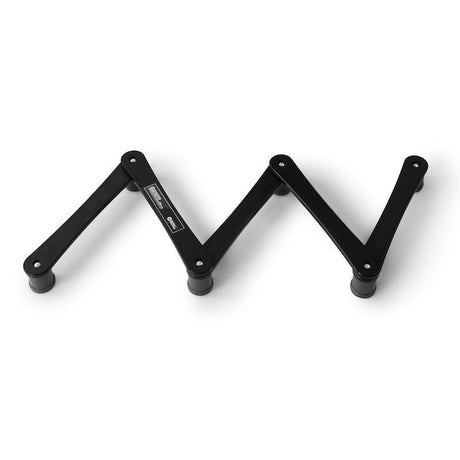
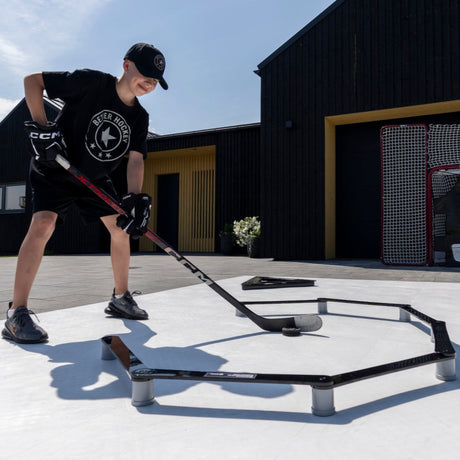
For Thursday's obstacle day, a stickhandling trainer folds flat for storage and sets up in 10 seconds — its blade-height bars force the full-reach moves that cones can't. Drill cones are the budget alternative. Full drill descriptions with reps are in our stickhandling drills library.
Coach Erik's tip: On Friday's heads-up day, don't just stare at a wall — have a parent or sibling flash fingers at random and call out the count while you dribble. Scanning for changing information is the real game habit; a fixed spot on the wall is only step one.
This video shows the core moves in a home setup:
Can you stickhandle in an apartment without annoying the neighbors?
Yes — stickhandling is the quietest hockey skill. Three noise-control rules:
- Wooden ball, not a puck. A wooden ball weighs about 55 g and rolls almost silently. Pucks (170 g) knock and scrape on hard floors.
- Train on a pad. A shooting pad dampens contact noise and saves the floor from blade scratches — the thing landlords actually complain about.
- Keep the blade on the surface. Quiet stickhandling is also correct stickhandling: the blade should slide, not chop. If your downstairs neighbor can hear you, your hands are too hard — same fix for both problems.
Evening sessions on a pad with a wooden ball are realistically as loud as normal walking. Skip bouncing golf-ball-style drills indoors entirely.
Coach Erik's tip: Small space is a feature, not a limitation. When the doormat zone feels easy, tape a smaller box inside it and keep every touch in there — shrinking the space forces the quick, quiet hands that big open areas never demand. I use the same trick on full ice with elite groups.
Adapting home stickhandling for kids
Kids' hands develop fast with tiny daily doses — but only if it feels like play:
- Ages 5–7: 5 minutes max, all games. "How many times around the cereal box in 30 seconds?" Beat-your-record beats instructions. Use a light ball and a cut-down stick (chin height in shoes).
- Ages 8–10: 8–10 minutes. Introduce the weekly plan above but halve every set. Add obstacle slalom races against a sibling or a stopwatch. Watch for: eyes glued to the ball — make heads-up laps worth double points.
- Ages 11+: the full plan as written. Add the Saturday test day — kids this age love beating their own numbers.
One rule for parents: if it stops being fun, stop for the day. Ten enthusiastic 5-minute sessions beat one forced 50-minute one. More game ideas in our kids' drills guide.
Common mistakes
- Using a puck on bare concrete or asphalt. It ruins the blade and teaches false feel. Fix: ball on bare floor, puck only on a pad or tiles.
- Waiting for a "proper setup". A doormat-sized space works today. Fix: start with the ball you can buy for pocket money; upgrade later.
- Training only when motivated. Fix: leave the stick and ball visible in your training spot — friction kills habits more than laziness.
- Watching the ball the whole session. Fix: Friday is heads-up day, and the last set of every drill is eyes-up every day.
- Standing tall because "it's just hands". Fix: knees bent, hockey stance, every session — posture is part of the rep.
- No progress tracking. Fix: Saturday test day, three numbers in a notebook. A month of data is the best motivation there is.
FAQ
How much space do I need to practice stickhandling at home?
About 60×90 cm (2×3 ft) — the size of a doormat — covers dribbles, toe drags, and one-hand work. A 2×2 m garage corner adds room for obstacle weaves and figure-eights.
What surface is best for stickhandling at home?
Any smooth bare floor works with a wooden stickhandling ball. For real-puck training, use a shooting pad or interlocking training tiles — both give near-ice glide and protect your stick blade and the floor.
Is stickhandling practice too loud for an apartment?
No — a wooden ball on a shooting pad is about as loud as walking. Avoid pucks on hard floors and any bouncing drills. Quiet, sliding blade contact is also technically correct stickhandling.
Do I need training tiles or is a shooting pad enough?
A pad is enough for stationary hands work and costs less. Tiles make sense when you want to move while stickhandling — figure-eights, weaves, walking dribbles — or want a permanent 45+ sq ft zone in a garage or driveway.
How long until home stickhandling practice shows up in games?
With 10 minutes a day, most players notice better control in 3–4 weeks and see game-level change — moves without looking down — around 8–10 weeks. Track weekly test numbers so you can see it happening.
What should a child use for stickhandling at home?
A light wooden ball, a stick cut to chin height in shoes, and any smooth floor. Keep sessions to 5–10 minutes and make everything a game or a race. From age 11 kids can follow the full weekly plan.
Summary
Stickhandling is the most home-friendly skill in hockey: a doormat of space, a wooden ball, ten minutes a day. Match the tool to your surface (ball on bare floor, puck on a pad or tiles), follow the weekly plan, and test yourself every Saturday.
Go deeper: technique fundamentals in how to improve stickhandling, the full 12-drill library in best stickhandling drills, and the complete space setup in hockey training at home. More in the stickhandling hub.