Quick answer
The dekes every player needs are the toe drag, forehand-to-backhand (the "basic"), the between-the-legs, the Michigan, the poke-and-go, the fake shot, the backhand sweep, and the spin move. Start with the first three — they work at every level. The key principle behind all of them is the same: sell the fake with your eyes and shoulders before you move the puck. The puck doesn't fool the defender; you do.
Key takeaways
- Your eyes and shoulders sell the deke — a puck move without body deception rarely works above Bantam level.
- Learn dekes in order: basic forehand-to-backhand first, then toe drag, then advanced moves. Skipping steps creates flashy moves that fall apart under pressure.
- Every deke has an entry speed: too slow and the defender waits; too fast and you can't control the puck. Game-speed practice is non-negotiable.
- Off-ice repetitions build the hand-feel. A stickhandling trainer and a stickhandling ball let you practice dekes 365 days a year regardless of ice access.
- The Game Changer 1v1 mode trains the decision-making — when to go, when to hold — not just the mechanics.
- Dekes you can't execute at 80% of full skating speed aren't game-ready.
What makes a deke actually work?
A deke is 30% puck movement and 70% body deception. The best players I've coached can make a defender commit with a head fake and a shoulder dip before the puck ever moves. Without that setup, even a perfectly executed toe drag fails because the defender is still square and in position.
Three body parts sell the fake in order of importance:
- Eyes. Look where you are NOT going, right up until the moment you go. If your eyes telegraph the move, the defender reads it before your body does it. Cue: "eyes fake first."
- Shoulders. A dip of the outside shoulder sells the body weight shift. This happens at the same time as your eyes — a half-second before the puck moves.
- Hips and feet. Your stride pattern either confirms or betrays the fake. Taking a step in the fake direction locks the defender.
Coach Erik's tip: When I watch players try dekes that don't work, it's almost always because they go straight to the puck move. Practice the head fake and shoulder dip on their own — no puck — until the body language is convincing. Then add the puck.
The 8 dekes: what they are, when to use them

| Deke | Level | When to use it | Key cue |
|---|---|---|---|
| 1. Forehand-to-backhand (the "basic") | Beginner | Defender plays your forehand side; open lane on backhand | Pull puck to backhand in one smooth motion |
| 2. Backhand-to-forehand | Beginner | Defender shades backhand; you want to finish on forehand | Push puck back to forehand with bottom hand |
| 3. Fake shot | Beginner–Intermediate | Defender backs up expecting a shot | Full wind-up but no release; drive wide |
| 4. Toe drag | Intermediate | Defender poke-checks; tight gap; need to protect puck | Pull puck back with toe, keep body between puck and defender |
| 5. Poke-and-go (speed deke) | Intermediate | Open ice, 1-on-1 with speed advantage | Push puck past defender's hip, win the footrace |
| 6. Spin move | Intermediate–Advanced | Forechecked from behind; board battles; protect puck under pressure | Full 360°, keep puck on forehand through spin |
| 7. Backhand sweep | Intermediate | Tight space, defender forces you to boards | Wide, sweeping motion; body shields the puck |
| 8. Between-the-legs / Michigan | Advanced | Shootout, breakaway, defender completely frozen | Michigan: scoop to backhand, lift over pad — only attempt when defender is off-balance |
Off-ice practice progression for each deke
Work through each deke in three stages. Do not rush stage 1 — bad habits formed slowly are the hardest to undo.
- Stage 1 — Slow hand drill (no skating). Stand in athletic stance on a stickhandling trainer with a ball. Execute the puck movement at 40% speed, stopping and holding the end position for 2 seconds. 3 sets of 10 reps per deke. Goal: clean hand pattern with zero puck loss.
- Stage 2 — Full speed, isolated. Same setup, full hand speed, no skating. 5 sets of 10 reps. Introduce the eye fake and shoulder dip as you increase speed. Move to Stage 3 when you can execute the full hand pattern plus body fake with less than 1 puck loss per 10 reps.
- Stage 3 — Against a passive defender. Use a Pro Defender as a stationary obstacle, then ask a partner to stand and react. Execute the deke at approach speed. Track how many times the defender bites the fake. Goal: 7 of 10 defenders commit before the puck moves.
Coach Erik's tip: The toe drag specifically needs wrist strength to be sharp at game speed. I have players work 3 minutes of slow toe drags with a heavy puck at the start of each stickhandling session. Two weeks of that and the regular puck feels like nothing.
Deke combinations that work together
Defenders adapt. Once you've used the same deke twice in a game, the third attempt rarely works. Combination fakes change that — the defender is reacting to a pattern, not a single move.
- Fake shot + toe drag: Wind up for the shot (defender backs off or lunges for the poke check), then drag the puck back and drive to the backhand side. Works on any defender who respects your shot.
- Forehand-to-backhand + backhand-to-forehand: Two-move shuffle at speed — pull backhand, then push back forehand before the defender recovers. The second move is almost always open if the first is sharp enough.
- Poke-and-go + spin: Push the puck past the defender, if they body-check, spin out the back — the spin gets you out of trouble if the speed deke doesn't fully clear.
Training the decision-making: Game Changer 1v1 practice
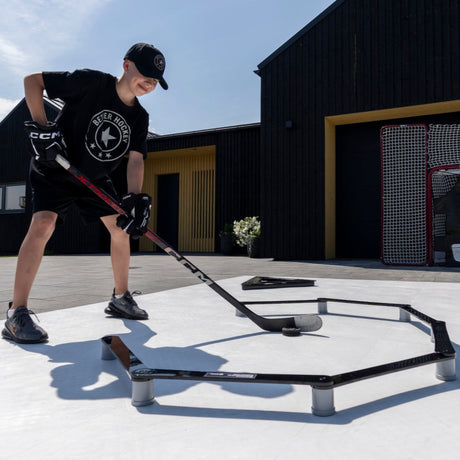
Hands aren't the limiting factor in most players. The decision — which deke, which side, and exactly when — is what breaks down under pressure. The Game Changer 1v1 mode is the best off-ice tool for this. One player stickhandles on the board; the other stands opposite and physically tries to cut off the approach. The puck-carrier has to read the defender's position and choose the correct move in real time.
Run 1v1 sessions like this: 5 reps per attacker, then switch. Limit the attacker to one specific deke per round. In round two, allow any deke — the defender has a 50% chance of guessing right. Track which dekes get through and which don't. That data tells you which moves are actually game-ready versus which ones only work against themselves in the mirror.
Watch the Game Changer 1v1 drill in action:
Common mistakes
- Telegraphing with the eyes. Looking at the open lane before the fake gives the defender a full second of warning. Fix: practice staring directly at the defender's chest throughout the fake.
- Executing at walking speed. A slow deke gives the defender time to recover even after committing. Fix: drills where you must reach a cone within 2 skating strides of the fake completing.
- Puck too far from the body. An extended puck is easy to poke off. Fix: practice the toe drag and forehand-to-backhand with the puck pulled close to your skates, body curled protectively around it.
- Skipping Stage 1 training. Trying to learn the Michigan at full speed before the basic forehand-to-backhand is sharp. Fix: the progression table above — in order, no shortcuts.
- Only using one deke. Even the best move stops working after the second attempt in a game. Fix: practice at least three dekes in every session, not just your favourite.
FAQ
What is the easiest deke to learn in hockey?
The forehand-to-backhand — pulling the puck from your forehand to your backhand side in a single sweeping motion — is the foundation. Every other deke either builds on it or uses it as a setup. Master this first before learning anything else, and it will remain effective at every level when executed with the right body fake.
What is a toe drag in hockey?
A toe drag pulls the puck backward and inward using the toe of the blade, typically used to protect the puck from a poke check or to create space by pulling the puck away from an approaching defender. The puck starts wide, the blade catches it at the toe, and you drag it back under your body. Strong wrists and blade control make the drag sharp enough to be game-effective.
How do you get a defender to bite on a deke?
Sell the fake with your eyes and shoulders before the puck moves. Look where you are NOT going. Drop the outside shoulder toward the fake direction and take a partial step that way. Defenders react to body weight, not puck position — if your body commits to a direction, most defenders follow. Only then move the puck the other way.
How many dekes should a youth hockey player know?
Beginners should master two: the forehand-to-backhand and the fake shot. Those two moves cover most situations at Squirt and Peewee levels. Add the toe drag at Bantam when the poke check becomes a real threat. Advanced moves like the between-the-legs work only when the fundamentals are completely automatic — usually at least 2–3 years of consistent off-ice practice.
Can you practice dekes off the ice?
Yes — the hand mechanics are fully trainable off-ice. A stickhandling trainer and a ball let you drill the motion pattern, wrist strength, and blade control. The only element you cannot replicate is the full-speed skating approach, which is why the Stage 3 progression with a stationary defender is important — it adds the timing element that separates practice reps from game reps.
What is the Michigan deke?
The Michigan is an advanced move where the player scoops the puck onto the backhand, carries it on the blade, and lifts it over the goalie's pad and into the top corner in one motion — like scoring from beside the net. It requires exceptional blade control, wrist strength, and confidence. Technically, it's legal in a game and has been scored successfully at the NHL level, but it is only worth attempting when a defender is completely frozen and not in a position to poke the puck off the blade.
Summary
Eight dekes cover every situation in the game, but most players need only three well-practiced moves plus the ability to combine them. Start with the basic forehand-to-backhand, add the toe drag and fake shot, then build upward. Sell every fake with eyes and shoulders before the puck moves. Drill the hand pattern off-ice with a stickhandling trainer, progress against a Pro Defender, and sharpen the decision-making with Game Changer 1v1 sessions.
Related reading: How to improve your stickhandling, best hockey stickhandling drills, and stickhandling at home.