Quick answer
The best stickhandling drills follow a simple progression: master narrow and wide dribbles first, add figure-eights and toe drags, then move to one-hand control, obstacle weaves, and heads-up games under time pressure. Below are 12 drills organized by level with exact times and reps — pick 4–5 per session, train 10–15 minutes a day, and move up a level when you can do every drill in your current level with your eyes off the ball.
Key takeaways
- 12 drills, three levels — beginner, intermediate, advanced — with times and reps for each.
- Move up when you can run every drill in your level heads-up without losing control.
- Slow and perfect first, then fast: 10 clean reps before every speed set.
- A ball on bare floor works for every drill; a puck on a pad or tiles makes them game-realistic.
- Obstacles (cones, a stickhandling trainer, a defender triangle) are what turn practice hands into game hands.
- A full session is 4–5 drills, 10–15 minutes, six days a week.
What you need
Bare minimum: your stick and a stickhandling ball on any smooth floor. To make drills game-realistic, add a puck plus a shooting pad or training tiles, a set of drill cones, and for the obstacle drills a stickhandling trainer or Pro Defender. Everything below fits in a garage corner.
Beginner drills (weeks 1–3)
- Narrow dribble. Quick taps directly in front of you, ball moving no wider than the blade. 3 × 45 seconds. Grip at 4–5/10 pressure; last set eyes up.
- Wide dribble. Full-reach side to side, forehand to backhand, cupping the ball with the blade each way. 3 × 45 seconds. Bend your knees — hockey stance the whole time.
- Front-to-side switches. 5 dribbles in front, 5 at your forehand side, 5 at your backhand side, repeat. 3 × 60 seconds. Builds control in every puck position.
- Figure-eights. Two cones or pucks 60 cm (2 ft) apart; weave the ball around them in an eight. 3 × 60 seconds. Count laps and write down your best.
Coach Erik's tip: The beginner error I correct most is a wide dribble that quietly shrinks into a narrow one after ten reps. Drop a glove just outside each edge of your reach and make the ball pass it every time — the rep only counts at full extension.
Intermediate drills (weeks 3–8)

- Toe drags. Push the ball out, reach, roll the blade over and pull it back with the toe. 2 × 10 slow perfect reps, then 2 × 10 at speed, both sides. Cue: "roll, don't scoop" — the wrists turn the blade over the ball.
- One-hand top-hand dribble. Bottom hand off the stick. 60 seconds narrow, 60 seconds wide arc forehand-to-backhand. 2 rounds. This is the single highest-value drill on the list.
- Around-the-body. Move the ball in a full circle around your feet — front, forehand side, behind (switch to backhand), backhand side — without moving your feet. 5 circles each direction × 3.
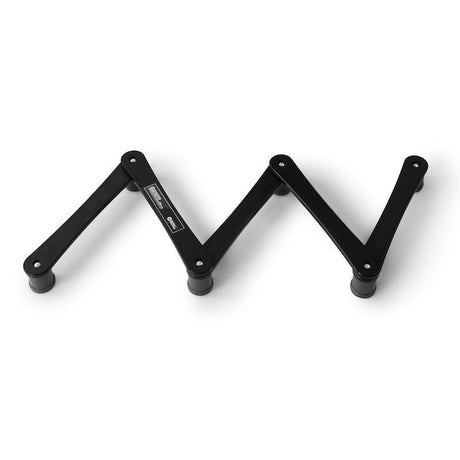
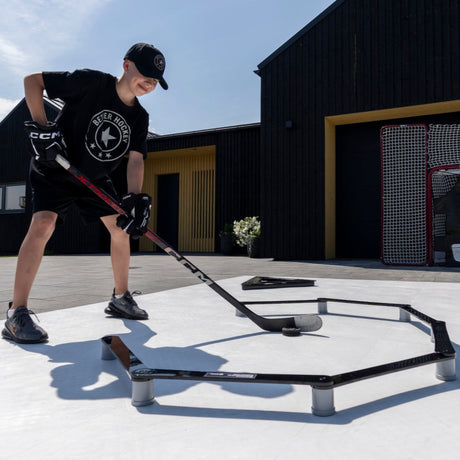
- Obstacle weave. Zig-zag the puck through a stickhandling trainer's openings end to end. 10 passes through, then 5 timed — beat your time each session. No trainer yet? Use 4 cones in a line, 50 cm apart.
Here's a full drill session using the obstacle setup:
Advanced drills (week 8+)
- Defender escapes. Stickhandle in place next to a Pro Defender (or a chair), then explode the puck under the stick and out the other side — like beating a poke check. 10 reps each side × 2. Add a fake before the escape in round two. Cue: sell the fake with your eyes and shoulders, not just the blade.
- Heads-up reading drill. Tape a page of text on the wall at eye height. Stickhandle for 60 seconds while reading it out loud. 3 rounds. Goal: zero glances down. Harder version: a parent flashes fingers and you call the number.
- Two-object juggle. One ball and one puck, alternating touches — dribble the ball twice, the puck twice. 3 × 45 seconds. Brutal for blade feel and peripheral vision.
- Beat-the-clock circuit. Chain drills 4, 5, and 8 back to back: 5 figure-eights, 10 toe drags, 5 trainer weaves, timed. 3 attempts, 60 seconds rest between. Log the best time weekly.
Drill progression table
| # | Drill | Level | Dose | Focus |
|---|---|---|---|---|
| 1 | Narrow dribble | Beginner | 3 × 45 s | Quick hands |
| 2 | Wide dribble | Beginner | 3 × 45 s | Reach, cupping |
| 3 | Front-to-side switches | Beginner | 3 × 60 s | Puck positions |
| 4 | Figure-eights | Beginner | 3 × 60 s | Control on the move |
| 5 | Toe drags | Intermediate | 4 × 10 reps | Blade roll, reach |
| 6 | One-hand dribble | Intermediate | 2 × 2 min | Top-hand control |
| 7 | Around-the-body | Intermediate | 3 × 10 circles | 360° puck control |
| 8 | Obstacle weave | Intermediate | 10 + 5 timed | Reach under pressure |
| 9 | Defender escapes | Advanced | 2 × 20 reps | Beating sticks |
| 10 | Heads-up reading | Advanced | 3 × 60 s | Eyes off the puck |
| 11 | Two-object juggle | Advanced | 3 × 45 s | Feel, peripheral vision |
| 12 | Beat-the-clock circuit | Advanced | 3 attempts | Speed under fatigue |
How to build a session
Don't do all 12 — pick like a coach. This is how I build sessions for my own groups:
- Warm up with drills 1–2 (3 minutes), every session regardless of level.
- Main block: 3 drills from your current level (7–9 minutes).
- Finisher: one timed or heads-up drill (2–3 minutes) so every session ends with pressure.
Move up a level when you can run all your current drills heads-up with fewer than 2–3 losses of control per drill. Most players I train spend 2–3 weeks at beginner, 4–6 at intermediate. If you want a structured obstacle setup for levels 2–3, the Super Skills Kit bundles the trainer, defender, and balls in one package.
Coach Erik's tip: When a drill gets easy, shrink it before you speed it up — move the figure-eight cones from 60 to 40 cm, or weave through every second opening on the trainer. Less space forces quicker hands and quicker decisions, which is exactly what the game asks for.
Common mistakes
- Doing every drill at max speed. Speed with sloppy hands trains sloppy hands. Fix: 10 slow, perfect reps before each fast set.
- Staying at beginner drills forever. Comfortable isn't improving. Fix: apply the heads-up promotion test every two weeks.
- Eyes locked on the ball. Fix: make the last set of every drill heads-up, from day one.
- Standing upright. Fix: knees bent, chest up — if your legs aren't tired, your stance is wrong.
- Random drill-hopping. Fix: same 4–5 drills for a full week, then rotate. Repetition builds automatic hands.
- No numbers. Fix: log one metric per session (figure-eight laps, weave time). What gets measured improves.
FAQ
How many stickhandling drills should I do per session?
Four to five drills for 10–15 minutes total: a 3-minute warm-up dribble, three drills from your level, and one timed or heads-up finisher. Quality beats quantity — a focused 12 minutes daily outperforms an unfocused hour.
What is the single best stickhandling drill?
One-hand top-hand dribbling. Your top hand controls 70–80% of every move, and this drill isolates it completely. Two minutes a day fixes more stickhandling problems than any other single exercise.
Can I do these drills without a stickhandling trainer?
Yes — 9 of the 12 drills need only a ball and flat floor, and cones or household objects substitute in the obstacle drills. A trainer adds blade-height bars you must reach under, which cones can't replicate, so it becomes worth it at the intermediate stage.
How often should I practice stickhandling drills?
Six days a week, 10–15 minutes. Hand skills respond to frequency more than volume — daily short sessions build and keep feel, while once-a-week marathons let it fade between sessions.
Are these drills suitable for kids?
Beginner drills work from about age 6–7 — just cut sets to 20–30 seconds and keep it playful with lap-counting games. Kids can usually start intermediate drills around age 9–10. See our kids' drills guide for fun-first versions.
Should I use a ball or a puck for these drills?
Both: a wooden ball on bare floor for daily work anywhere, a puck on a pad or tiles whenever you have the surface. The ball builds quickness, the puck builds game feel — the combination transfers best to the ice.
Summary
Twelve drills, three levels, one rule: earn your promotion heads-up. Start with narrow and wide dribbles, build through toe drags and one-hand work, and finish with defender escapes and timed circuits. Pick 4–5 drills, train 10–15 minutes six days a week, and log one number per session.
For the technique behind these drills, read how to improve stickhandling. Setting up your space? See stickhandling at home and the complete home training guide. More in the stickhandling hub.