Quick answer
Passing accuracy improves fastest with high-repetition target passing: 50–100 passes per session against a rebounder or passer, aiming at a specific spot, not just "back and forth". Work through three progressions — stationary accuracy, one-touch passing, and saucer passes — and score every set (hits out of 10) so each session has a number to beat. Fifteen minutes a day, and your tape-to-tape percentage climbs within two to three weeks.
Key takeaways
- Accuracy is built by aiming small: pick a 10 cm spot on the target, not the general direction.
- A rebounder or passer returns every pass, so one player gets 100+ reps in 15 minutes — no partner needed.
- Progress in order: stationary → moving feet → one-touch → saucer.
- Score every drill (hits out of 10). Accuracy without a score is just puck movement.
- Firm passes, blade cupped on release, follow-through pointing at the target.
- 10 drills below with exact reps, plus scoring games that make solo practice competitive.
What makes a pass accurate?
Three mechanical checkpoints, in order of importance:
- Follow-through at the target. The blade finishes low and pointing exactly where you aimed. If your follow-through drifts up or across, so does the puck.
- Puck released from the middle of the blade, rolling to the toe. Sweeping, not slapping. A slapped pass leaves the blade at an unpredictable angle.
- Weight moving toward the target. Step or shift into the pass. Arm-only passes die halfway and wander.
- Receiving counts too: cushion the incoming puck with a slightly angled blade ("soft hands"), because most missed passes in games are actually missed receptions.
Coach Erik's tip: When a player's passes wander, the first thing I check isn't the release — it's the feet. Weight stuck on the back foot makes the follow-through drift across the body. Fix the step toward the target and the accuracy usually fixes itself.
Solo passing: rebounder and passer drills

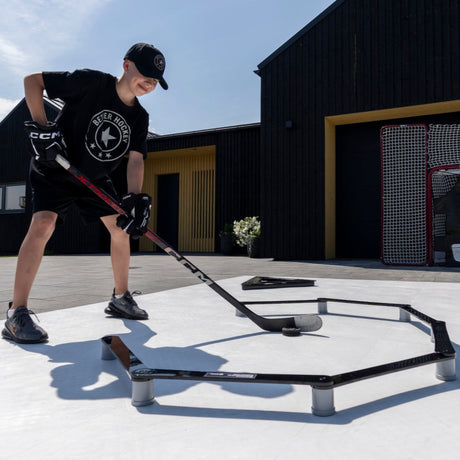
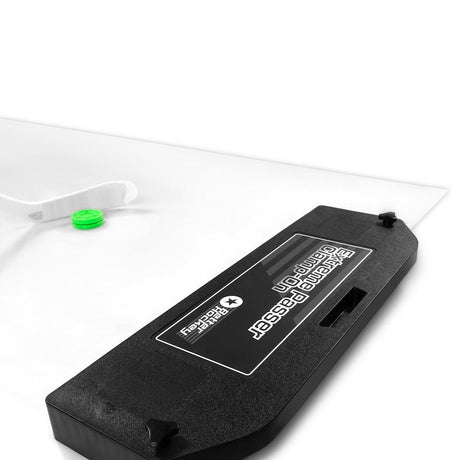
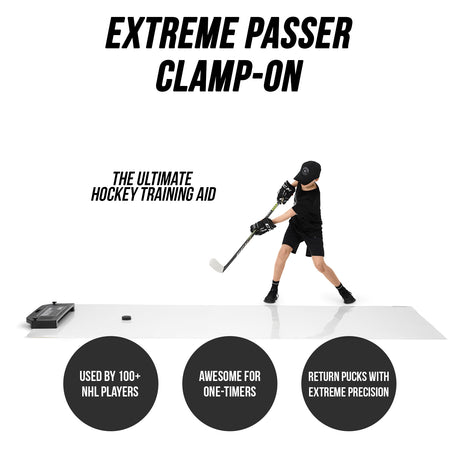
Passing is the most undertrained skill I see in young players, and the reason is the partner problem — solved by a bungee-band rebounder. An Extreme Rebounder fires the puck back at game speed; a Triangle Passer gives you return angles from three sides; and the Xtreme SmartBox Passer clamps to a pad or tiles for a fixed, consistent return. Core solo drills:
- Spot passing. Mark a 10 cm spot on the rebounder band with tape. 5 × 10 passes at the spot from 3 m (10 ft). Score each set out of 10. Cue: "aim small, miss small."
- Forehand–backhand alternating. 4 × 10 passes, switching every rep. The return forces an honest reception each time.
- Walk the arc. 3 × 10 passes while sidestepping along a half-circle around the rebounder — every pass comes from a new angle, like moving on the ice.
- Triangle rotation. With a Triangle Passer, pass, rotate 120° to the next side, receive and pass again. 3 × 60 seconds. Trains passing out of a turn.
- Receive-and-move. Pass, receive, take two quick stickhandles sideways, pass from the new position. 3 × 10. No standing still after the catch — and eyes up during the stickhandles, finding your next target before you release.
One-touch and saucer pass progressions
Once stationary passes hit 8/10, add the two game-changing layers:
One-touch progression
- Cushioned one-touch: return the rebounder's pass in one motion, allowing a small cushion. 3 × 10 each side.
- True one-timers off the pass: no cushion — redirect the return straight back at your tape spot. 3 × 10. Start soft; power comes after accuracy. Watch for: the blade opening on contact — keep it cupped.
- One-touch on the move: combine with the walk-the-arc drill — one-touch returns while sidestepping. 2 × 10.
Coach Erik's tip: When one-touch returns get comfortable, don't pass harder — take a step closer to the rebounder. Cutting the distance shrinks your reaction time the way a forechecker does, and I've watched hands speed up within a week from that one change.
Saucer pass progression
A saucer pass needs the puck to slide off the toe with spin, flatten in the air, and land flat. Train it as a target game with a Sauce Combo kit — pad on one end, catching net on the other:
- Over the stick: lay a stick (or the sauce kit's barrier) between you and a target 2 m away. 20 attempts, count clean landings.
- Into the net: sauce from 3–4 m into the catcher net. 20 attempts, score out of 20.
- Distance ladder: 5 attempts each from 3, 4, 5, and 6 m. Your "sauce range" is the longest distance where you land 3 of 5 — push it weekly.
See the passing setup in action here:
Accuracy scoring games
Scored games turn 100 reps from a chore into a competition — against yourself or anyone in the garage:
- 21. Spot passes from 3 m: middle of the band = 1 point, taped spot = 3. First to exactly 21; going over resets you to 15.
- Around the world. 5 passing stations in an arc around the rebounder. Hit your spot to advance; miss twice and you restart. Time the full lap.
- Sauce golf. 9 "holes" = 9 saucer targets at different distances (buckets, the sauce net, a shooting pad). Count attempts per hole; lowest total wins.
- Pressure minute. How many taped-spot hits in 60 seconds? Misses subtract one. Log the score every Saturday.
Partner drills
When you do have a partner, use them for what a rebounder can't do — unpredictability:
- Call-the-target: receiver calls "forehand!" or "backhand!" as the pass leaves the blade. 3 × 10 each way.
- Two-puck tempo: two pucks in constant motion between you — the instant you pass one, the next arrives. 3 × 60 seconds. Punishes slow hands and lazy receptions.
- Moving-lane passes: partner walks laterally; hit their moving blade. 3 × 10, then swap. Lead the target, don't chase it.
- Sauce tennis: saucer passes back and forth over a stick with the sauce kit; clean catch = 1 point, first to 11.
Passing drill table
| Drill | Type | Reps/time | Distance | Score it |
|---|---|---|---|---|
| Spot passing | Solo | 5 × 10 | 3 m | Hits /10 per set |
| Forehand–backhand | Solo | 4 × 10 | 3 m | Clean receptions /10 |
| Walk the arc | Solo | 3 × 10 | 3–4 m | Hits /10 |
| Triangle rotation | Solo | 3 × 60 s | 2–3 m | Passes per minute |
| Cushioned one-touch | Solo | 3 × 10 each side | 3 m | Returns on spot /10 |
| One-touch on the move | Solo | 2 × 10 | 3 m | Clean redirects /10 |
| Sauce over stick | Solo | 20 attempts | 2 m | Flat landings /20 |
| Sauce distance ladder | Solo | 5 × 4 distances | 3–6 m | Longest 3/5 distance |
| Two-puck tempo | Partner | 3 × 60 s | 4 m | Drops per set (goal: 0) |
| Moving-lane passes | Partner | 3 × 10 each | 4–5 m | Tape hits /10 |
A full session = warm-up spot passing + two progressions + one scored game, about 15 minutes. Train on a smooth surface — a shooting pad line or tiles passing kit keeps passes flat and honest.
Common mistakes
- Passing at the rebounder, not at a spot. General-direction reps build general-direction passes. Fix: tape a 10 cm target and score every set.
- Slapping passes. Unpredictable release angle. Fix: sweep the puck from mid-blade to toe; the motion should be silent.
- Follow-through pointing nowhere. Fix: freeze your finish for one second — blade low, aimed at the spot.
- Only forehand. Games are half backhand. Fix: every drill alternates, no exceptions.
- Standing after receiving. Fix: catch-and-move built into every drill — two stickhandles or two steps after each reception.
- Saucing for height instead of landing. A pretty arc that lands on edge is a turnover. Fix: judge every sauce rep by whether it lands flat.
FAQ
How can I practice passing without a partner?
Use a rebounder or passer — an elastic band returns each pass at game speed, so you get 100+ receptions and passes in a 15-minute session. It's the fastest way to build accuracy because you also train receiving on every rep.
How many passes should I do per training session?
50–100 quality passes, all aimed at a specific spot and scored. That takes about 15 minutes with a rebounder. Three to four sessions a week produces visible tape-to-tape improvement within two to three weeks.
What distance should I practice passing from?
Start at 3 m (10 ft) for mechanics, and extend to 5–6 m as accuracy hits 8/10. For saucer passes, use a distance ladder from 3 to 6 m and track the longest distance where you land 3 of 5 flat.
How do I improve my saucer pass?
Release the puck off the toe of the blade so it spins, aim for a flat landing rather than a high arc, and train it as a target game — over a stick, then into a sauce net, then down a distance ladder. Judge every rep by the landing, not the flight.
What surface do I need for passing practice?
Any smooth surface where a puck slides flat: a shooting pad, training tiles, or smooth concrete with a ball. Rough asphalt makes passes bounce, which teaches your blade the wrong feel.
Are one-timers and one-touch passes the same drill?
Related but different: a one-touch pass redirects the puck to a target in one motion, while a one-timer is a shot taken directly off a pass. Train one-touch passing first — the timing and blade angle you build there is exactly what one-timers are made of.
Summary
Accurate passing is a numbers game with a target: 50–100 scored passes a session against a rebounder or passer, progressing from stationary spots to one-touch to saucer ladders, with a scored game to finish. Fifteen minutes, three to four times a week, and count your hits.
Build the full setup with our home training guide, pair passing days with stickhandling drills, and find more in the passing hub and off-ice training library.