Quick answer
This is a complete 7-day off-ice hockey workout program: six training days of 25–40 minutes covering shooting, stickhandling, passing, strength, speed, and slide board conditioning, plus one rest day. Every session lists exact sets, reps, and minutes, with a beginner and an advanced version of each day. Run it for four weeks, track your numbers, and you will feel the difference on the ice — harder shot, quieter hands, faster legs.
Key takeaways
- Six short sessions beat two long ones — the program averages just over 30 minutes a day.
- Every skill gets two touches per week: two shooting days, two hands/passing days, two athletic days.
- Beginners scale by volume (fewer sets), not by skipping days — the weekly rhythm is the point.
- Slide board intervals are the closest thing to skating you can do in socks.
- Hard conditioning sits the day after games in-season, never the day before.
- Log four numbers each week: shots on target, radar top speed (optional), slide board sets, sprint count.
How the program works
The plan follows a simple rule: skills daily, athletics twice, rest once. Skill sessions (shooting, stickhandling, passing) are high-frequency because coordination improves with daily exposure. Strength and conditioning need 48 hours of recovery, so they alternate. Total weekly time: about 3 hours — less than most players spend scrolling highlights.
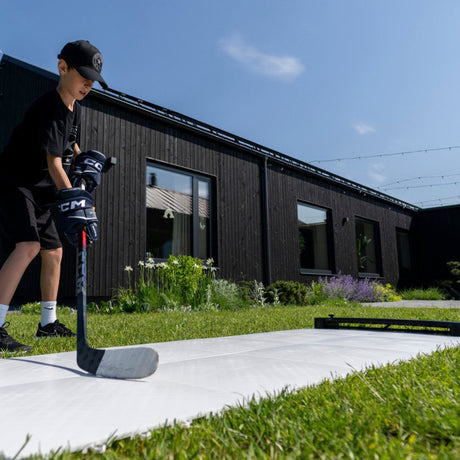
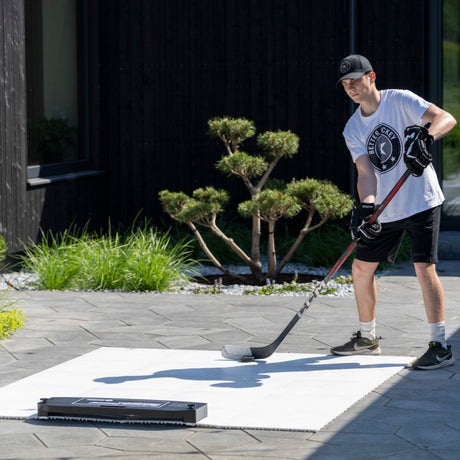
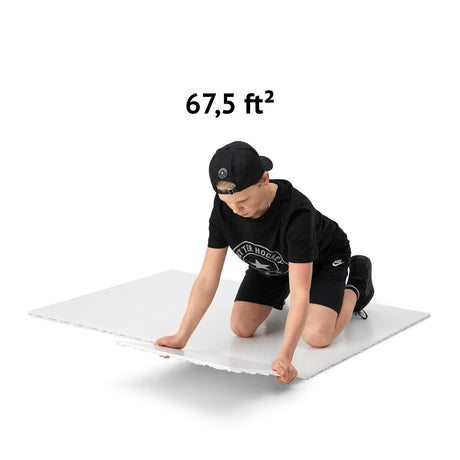
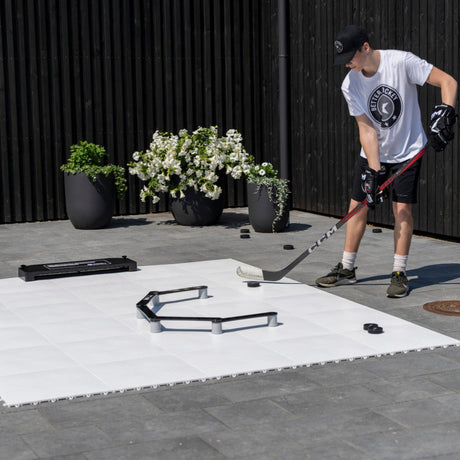
Equipment: a shooting surface, pucks, a stickhandling ball, and something that returns passes. The two athletic days use a slide board and a speed chute; bodyweight substitutions are listed for both. If you are still setting up your space, start with Hockey Training at Home, and for the reasoning behind each pillar see the parent guide: The Ultimate Off-Ice Hockey Training Guide.
Coach Erik's tip: Most players I train want to skip straight to the power block on Monday and wonder why they're not getting stronger. The warm-up and mechanics block exist for a reason — ten easy shots at 50% activates the pattern before you load it. Players who skip the warm-up ingrain bad mechanics at high velocity. Do the easy shots first, always.
Here is what the athletic days look like in practice:
The 7-day off-ice hockey program
| Day | Focus | Session | Time |
|---|---|---|---|
| Monday | Shooting power | 100 shots: 25 mechanics, 25 heavy puck, 35 full power, 15 quick release | 30 min |
| Tuesday | Hands + passing | 12 min stickhandling + 50 rebounder passes + 20 saucer passes | 30 min |
| Wednesday | Strength | Lower body + core circuit, 3–4 rounds | 35 min |
| Thursday | Shooting accuracy | 100 shots, every one at a called target + 25 catch-and-shoot | 30 min |
| Friday | Hands + speed | 10 min stickhandling + 6–10 chute sprints + lateral bounds | 35 min |
| Saturday | Conditioning | Slide board intervals + finisher | 25–30 min |
| Sunday | Rest | Full rest or light free play | — |
Day-by-day details
Monday — Shooting power (30 min)
- Warm-up: 10 easy wrist shots, half effort. 3 min.
- Mechanics block: 25 wrist shots at 80% focusing on back-leg drive and stick flex. Cue: "drive the back knee, not the shoulders." 7 min.
- Overload block: 25 shots with a heavy puck, full weight transfer, 30 s rest per 10. 8 min.
- Power block: 35 normal-puck shots at full power. Radar if you have one — log top 3 speeds. 9 min.
- Finisher: 15 quick-release snaps, puck gone in under a second. Watch for: players who "load up" before the snap — the whole point is no preparation, just catch and release. 3 min.
Full technique breakdown: How to Shoot Harder in Hockey.
Tuesday — Hands and passing (30 min)
- Stickhandling: 4 min narrow/wide dribbles, 4 min figure-eights around obstacles, 4 min toe drags — head up throughout. Cue: "eyes up — count fingers a partner holds up while you handle." 12 min.
- Passing: 50 firm passes off the rebounder, alternating forehand/backhand. 8 min.
- One-touch: 25 per side, receive and return in one motion. 6 min.
- Saucer: 20 attempts over a stick onto a flat target. 4 min.
Wednesday — Strength (35 min)
- Warm-up: 5 min dynamic — leg swings, lunges, arm circles.
- Circuit, 3–4 rounds with 90 s rest between rounds: 12 squats (goblet if you have a weight), 8 split squats per leg, 10 hip bridges, 10 push-ups, 12 Russian twists per side, 40 s plank. 25 min.
- Wrists: 3 × 8 stick lifts per hand. 5 min.
Thursday — Shooting accuracy (30 min)
- 100 shots, call the corner out loud before every single one. Count hits; beat Monday's count. 20 min.
- 25 catch-and-shoot reps off the rebounder — one motion, no settle. 7 min. (Deep dive: Quick Release Training.)
- Pressure game: 10 shots, must hit 6 targets or repeat once. 3 min.
Friday — Hands and speed (35 min)
- Stickhandling: 10 min, add a stick weight for the first 5 minutes, then feel the normal stick fly.
- Sprints: 6–10 × 15–20 m with the speed chute (or hill sprints), full recovery — walk back slowly. 15 min.
- Lateral bounds: 3 × 6 per side, stick the landing for a full second. 5 min.
Saturday — Slide board conditioning (25–30 min)
The slide board loads the exact lateral stride of skating — knee bend, full leg push, low recovery — which is why it beats any bike or run for hockey conditioning. No board? Substitute lateral skater jumps at the same work-rest times.

- Warm-up: 3 × 30 s easy slides, focus on full push and low posture. 5 min.
- Main set: 6 × 40 s hard slides / 80 s rest — a shift, then bench time. Cue: "push all the way to the bumper, don't stop halfway." Watch for: players standing too upright — knees should stay bent to skating depth throughout. 12 min.
- Finisher: 2 × 60 s moderate slides, hands behind back, legs only. 5 min.
- Stretch: hips, groin, quads. 5 min.
Coach Erik's tip: I see players overdo the slide board every week — they hit their six intervals hard, feel good, and add two more "just to be sure." That extra work lands when you're already fatigued, so the quality drops and the recovery cost goes up. Six sets at high quality beats eight sets of tired striding. If Saturday feels easy, add five seconds of work per interval next week, not extra sets.
Sunday — Rest
Full rest, or unstructured play — shoot for fun, ride a bike, play another sport. No counting anything.
Beginner vs advanced scaling
Same week, different dose. Scale volume, never frequency:
| Session element | Beginner (first 4 weeks / under 12) | Standard | Advanced (14+, 2nd cycle) |
|---|---|---|---|
| Daily shots | 50 | 100 | 125 + radar log |
| Stickhandling | 6–8 min | 10–12 min | 12 min with stick weight |
| Strength circuit | 2 rounds, bodyweight | 3–4 rounds | 4 rounds, add load |
| Chute sprints | 4–6, no chute | 6–10 | 10, add 2 flying starts |
| Slide board main set | 4 × 30 s / 90 s rest | 6 × 40 s / 80 s | 8 × 45 s / 60 s |
| Session length | 15–20 min | 25–35 min | 35–45 min |
Progress one variable per week — more reps, or less rest, or more load. Never all three at once. In-season, run the beginner volumes even if you're advanced, and swap Saturday's conditioning to the day after your game. The players I've seen make the biggest jumps are the ones who resist the urge to do more — they add one small variable and let the weeks compound.
Common mistakes
- Skipping the athletic days. Players do the puck days and bail on Wednesday/Saturday — then wonder why they lose races. Fix: athletic days are non-negotiable; shorten them if needed.
- Racing through skill reps. 100 sloppy shots train sloppiness. Fix: every shot has a target, every dribble is head-up.
- No rest between sprints. Tired sprinting trains slowness. Fix: walk back fully — speed work needs full recovery, conditioning is Saturday's job.
- Upright slide board strides. Standing tall turns it into cardio for the wrong muscles. Fix: knees bent to skating depth, chest up, full push to the bumper.
- Doubling sessions to catch up. Missed Monday? Don't stack it on Tuesday. Fix: skip it and continue — the week's rhythm matters more than any single day.
- Not writing anything down. Fix: four numbers a week — shots on target, top speed, slide board sets, sprints. 60 seconds of logging.
FAQ
How many days a week should hockey players train off-ice?
Six short days with one full rest day works best in the off-season — skills daily, strength and conditioning twice each. In-season, cut to 3–4 sessions of 15–25 minutes and put hard conditioning the day after games, never the day before.
How long should each off-ice session be?
25–40 minutes. Skill sessions lose focus after about 30 minutes, and strength work for teenagers doesn't need more than 35. Short, sharp, and daily beats long and occasional every time.
Can beginners follow this program?
Yes — run the beginner column: 50 shots, 2 strength rounds, 4 slide board intervals, 15–20 minutes per day. Keep all six days so the weekly habit forms, and move to standard volumes after about four weeks.
What equipment do I need for this program?
Minimum: a shooting pad, pucks, a stickhandling ball, and a rebounder or wall that returns passes. The athletic days are best with a slide board and speed chute, but skater jumps and hill sprints substitute fine while you build your setup.
Is a slide board actually good hockey training?
It is the most skating-specific conditioning tool that exists off-ice: the lateral push, deep knee bend, and glide recovery mirror the stride almost exactly. Intervals of 30–45 seconds match shift length, so 6–8 sets simulate a period of hockey for your legs and lungs.
When will I see results from a weekly off-ice program?
Hands and shot feel sharper within 2–3 weeks because skill responds fastest. Strength and conditioning changes show in 4–6 weeks — stronger in battles, fresher in the third period. Complete one 4-week cycle, re-test your numbers, then start the next cycle at slightly higher volume.
Summary
One week, six sessions, every base covered: power shooting Monday, hands Tuesday, strength Wednesday, accuracy Thursday, speed Friday, slide board Saturday, rest Sunday. Scale with the beginner or advanced column, progress one variable per week, and log your four numbers. Four weeks from now the puck comes off your blade differently — and you'll have the notebook to prove why.
For the full reasoning behind each pillar, read the parent guide: The Ultimate Off-Ice Hockey Training Guide. Then browse the off-ice training library for deep dives on every session in this plan.