Quick answer
To shoot harder in hockey, fix three things in this order: weight transfer (drive off your back leg and finish over your front foot), stick flex (lean into the shaft so it loads and snaps), and hand position (top hand pulls back while the bottom hand pushes through, about 30–40 cm apart). Then add strength — legs, core, wrists — and overload training with a heavier puck. Players who combine mechanics work with 100 shots a day typically add 8–15 km/h to their shot within 8–12 weeks.
Key takeaways
- Shot power comes from the ground up: legs and body weight produce far more speed than arms ever will.
- Flex is free power — if your stick isn't bending, you're leaving 20–30% of your shot on the table.
- Wrist, core, and leg strength set your ceiling; 15 minutes twice a week raises it.
- Heavier pucks and a stick weight overload the exact shooting muscles, then a normal puck feels light.
- Measure your shot speed — training without numbers is guessing.
- Volume wins: 100 mechanically correct shots a day beats 300 lazy ones a week.
What actually makes a shot hard?
Puck speed is energy transfer. The chain runs: legs push against the ground → body weight shifts toward the target → core rotates → the stick shaft loads with flex → the blade releases everything into the puck. Break any link and the shot dies. Most players I train with a weak shot don't have weak arms — they have a broken chain, usually at weight transfer or flex.
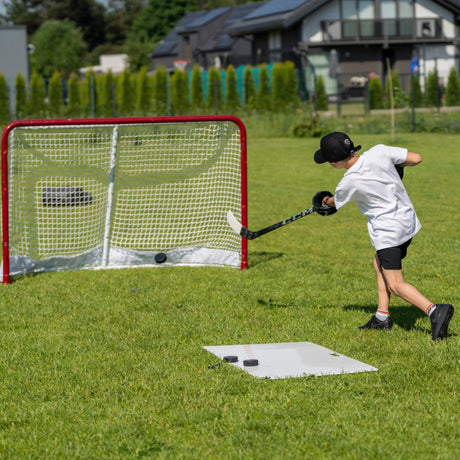
That's good news, because mechanics improve faster than muscle. Here is the full breakdown in action:
Weight transfer
Start with the puck behind your back foot and your weight loaded on the back leg. As you pull the puck forward, drive off that back leg and finish with your chest over your front knee. A hard wrist shot is closer to a hockey stop than an arm movement — you should feel your legs after a 50-shot session. If you don't, you're arm-shooting. Cue: "drive the ground away" — think of pushing the floor back with your back foot rather than swinging your arms forward.
Stick flex loading
The shaft is a spring. Load it by pressing your bottom hand down and into the shaft while the blade drags the puck — you should see the stick visibly bend before release. Two common flex killers: a stick that is too stiff (rule of thumb: flex rating at or below roughly half your body weight in pounds) and shooting with the puck too far from your body, where you can't get weight over the shaft. Watch for: the back elbow rising away from the body during the load — it kills shaft angle and costs you half your flex.
Coach Erik's tip: I see this every week at camps — players with strong bodies and weak shots because the stick never bends. Put your bottom hand on the shaft where you'd grip for a faceoff, lean your full body weight into it off a stationary puck, and hold for two seconds. If you can't see a clear bend, your stick is too stiff or your hand is too low on the shaft. Fix the equipment before you fix the mechanics.
Hand position and release
Bottom hand 30–40 cm below the top hand — lower gives leverage but slows the release. Through the shot, the top hand pulls back toward your body while the bottom hand punches forward: a lever action, not a sweep. Cue: "pull-punch, not sweep" — the top hand goes back as the bottom hand fires through. Finish by rolling wrists over and snapping the blade closed, pointing the toe of the blade at your target. That final wrist snap adds the last 10–15% of speed and all of the accuracy.
Strength work: wrists, core, legs
Mechanics decide how much of your strength reaches the puck; strength decides how much there is to transfer. This 15-minute routine, twice a week, covers the three shot-specific areas:
| Area | Exercise | Sets × reps | Why it matters |
|---|---|---|---|
| Wrists/forearms | Stick lifts (hold stick at knob, raise blade off floor) | 3 × 8 per hand | Blade control and final snap |
| Wrists/forearms | Wrist rollers or towel wrings | 3 × 30 sec | Grip endurance late in games |
| Core | Russian twists with a weight or heavy puck | 3 × 12 per side | Rotational power into the shot |
| Core | Plank with reach | 3 × 30–45 sec | Stable platform for the upper body |
| Legs | Split squats | 3 × 8 per leg | Back-leg drive |
| Legs | Lateral bounds | 3 × 6 per side | Explosive weight shift |
Overload training: heavy pucks and stick weight
Overload is how you turn strength into shot-specific power. Shoot and stickhandle with more resistance than game weight, and a regular 170-gram puck starts flying off your blade.
- Heavy pucks. A heavy training puck weighs roughly twice a game puck. Use it for 25–30 wrist shots per session, focusing on full weight transfer — it will not let you cheat with your arms. Then switch back to a normal puck for another 25 and feel the difference immediately.
- Stick weight. A stick weight straps onto your shaft and overloads every stickhandling move and shooting motion. Use it for 5 minutes of hands or 15–20 shots, then remove it — your normal stick suddenly feels like a toothpick.
Keep the ratio around 2:1 — roughly two normal-weight reps for every overloaded rep — so your release timing stays sharp. Overload builds power; normal weight keeps the speed of movement. A useful constraint drill: do your heavy-puck set, then immediately take 5 normal-puck shots as fast as you can release them — the contrast in feel locks in the muscle memory faster than either tool alone.

How do you measure shot speed progress?
You can't manage what you don't measure. A speed radar placed behind or beside the net reads every shot in km/h or mph and turns practice into a game — every session gets a top speed and an average. Test the same way each time: same distance (a stick length behind the hash marks, or a fixed 5–6 m at home), 10 shots, log the best 3.
Rough wrist shot benchmarks to calibrate expectations:
| Level | Typical wrist shot | Good target after 12 weeks |
|---|---|---|
| U12 | 55–70 km/h | +8–10 km/h |
| U15 | 75–90 km/h | +10–12 km/h |
| U18 / junior | 95–110 km/h | +8–12 km/h |
| Senior / pro | 110–130+ km/h | +5–8 km/h |
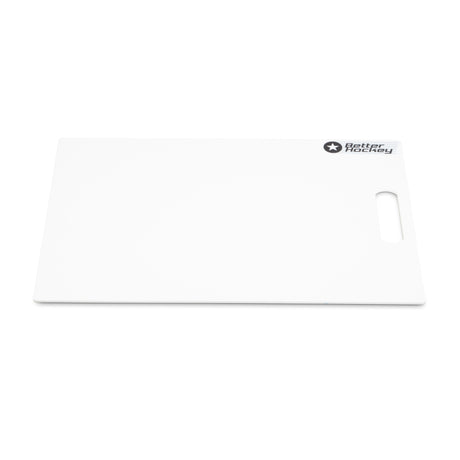
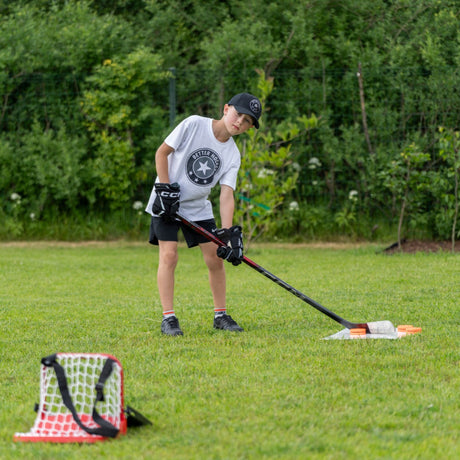
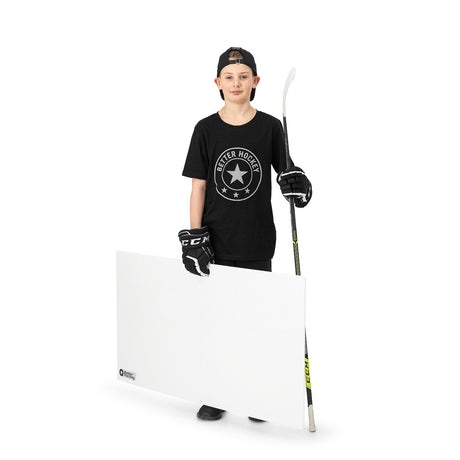
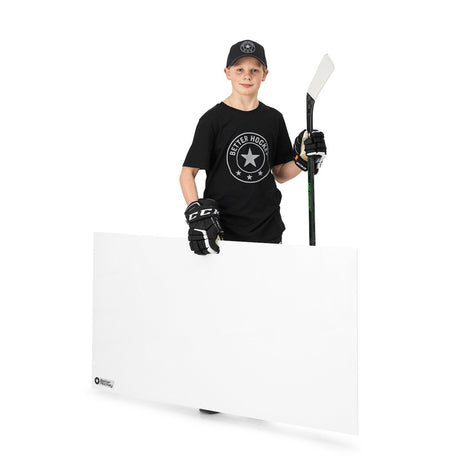
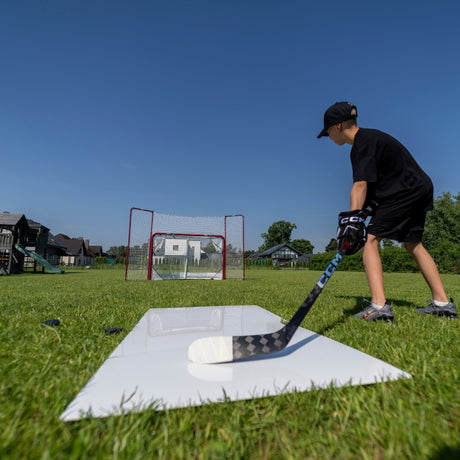
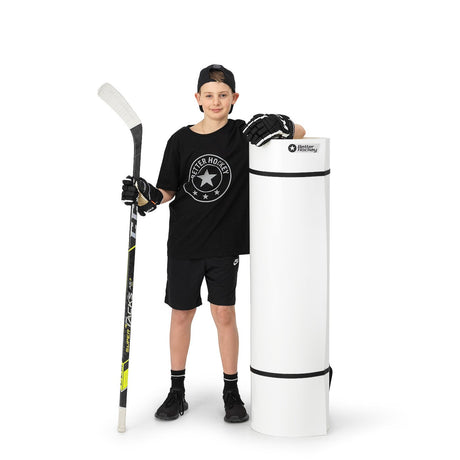
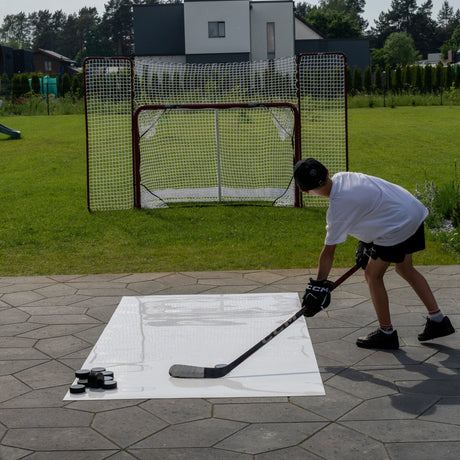
Shoot from a proper surface so the puck behaves like on ice — a pro shooting pad gives you room for the full pull-back motion that a harder shot needs.
The harder-shot workout: 100 shots, 25 minutes
- Warm-up — 10 easy wrist shots. Half effort, feel the blade roll from heel to toe.
- 25 mechanics shots. Slow-motion to 80% speed. One coaching cue per set of 5: back-leg drive, flex the shaft, chest over front knee, wrists snap, follow through at target.
- 25 heavy puck shots. Full weight transfer every rep. Rest 30 seconds every 10 shots — quality over gasping. Cue: "back foot off the ice" — if your back foot stays planted through the whole shot, you arm-shot it.
- 25 normal puck shots at full power. Radar on. Log your top 3 speeds.
- 15 quick-release shots. Puck arrives (or you pull it from a pile), shot gone in under a second — power means nothing if it comes too late. More on this in our quick release guide.
Run it 4–5 days a week. Add the strength routine twice a week on top and re-test speed every Sunday.
Common mistakes
- Arm shooting. Standing tall and sweeping with the arms. Fix: exaggerate the weight shift — finish every shot with the back foot coming off the ground.
- A stick that is too stiff. No bend, no spring. Fix: flex rating around half your body weight in pounds or less until you're full-grown.
- Puck too close to the body. Kills the leverage and the flex. Fix: start the puck behind the back foot, arm's length out.
- Only shooting heavy pucks. Timing goes slow and mushy. Fix: keep the 2:1 normal-to-heavy ratio.
- Chasing power, ignoring release. A 100 km/h shot that takes forever to load gets blocked. Fix: end every session with quick-release reps.
- Never testing. Twelve weeks of work with no numbers. Fix: radar test, same protocol, every week.
FAQ
How can I increase my shot power fast?
Fix weight transfer first — drive off the back leg and finish with your chest over the front knee. Most players add noticeable speed in 2–3 weeks from this change alone, before any strength gains, because they stop shooting with their arms.
Do heavier pucks really make you shoot harder?
Yes, used correctly. A heavy puck overloads the exact muscles and movement of shooting, like a weighted bat in baseball. Keep roughly two normal-puck shots for every heavy-puck shot so your release timing stays fast, and expect measurable gains in 4–6 weeks.
What stick flex should I use for a harder shot?
A common rule is a flex rating at or below about half your body weight in pounds — a 120 lb (55 kg) player fits a 50–60 flex. Too stiff is the most common mistake: if you can't see the shaft bend on your hardest wrist shot, go softer.
How hard should a hockey player shoot at each age?
Rough wrist shot ranges: 55–70 km/h at U12, 75–90 km/h at U15, and 95–110 km/h at U18/junior level. Individual variation is big, so measure your own baseline with a radar and compete against last month's numbers, not other players.
How many shots a day should I take to improve?
100 shots a day, 4–5 days a week, is the standard that development coaches keep coming back to — about 25 minutes of work. Structure beats raw volume: mix mechanics reps, overload reps, full-power measured shots, and quick-release finishes.
Can I train a harder shot without ice?
Absolutely — shot power is mostly built off-ice. A shooting pad, pucks, and a net cover everything in this article, and off-ice you get 100 reps a day instead of 15 at practice. The power transfers directly the next time you skate.
Summary
A harder shot is built in layers: mechanics first (weight transfer, flex, hand position), strength second (wrists, core, legs, twice a week), overload third (heavy pucks and a stick weight in a 2:1 ratio), and measurement always — a weekly radar test tells you the truth. Run the 100-shot workout 4–5 days a week and expect 8–15 km/h more within 8–12 weeks.
Keep building your shot with our guides on the wrist shot and quick release training, or zoom out to the full off-ice training guide and the rest of the shooting library.