Quick answer
To improve hockey shooting accuracy, stop shooting at the net and start shooting at targets: pick a spot 4–6 inches wide, call it before every shot, and track your hit rate. Goals are scored in the four corners and five-hole — the areas a goalie can't cover — so train those five spots deliberately. 30 called-target shots a day, scored and written down, will raise most players' hit rate from around 25% to over 50% in 6–8 weeks.
Key takeaways
- Accuracy is trained by aiming small: a 4-inch target, not a 6×4 ft net.
- Shoot where the goalie isn't: the four corners and the five-hole make up the roughly 15–20% of the net a set goalie leaves open.
- Call every shot out loud before you take it — uncalled hits don't count.
- Your follow-through aims the puck: the blade finishes pointing at the spot you want to hit.
- Score every session. Hit rate out of 30 is the single best accuracy metric.
- Once you hit 50%+, add speed pressure — accuracy that disappears under a quick release isn't game-ready yet.
Pick corners or shoot at the goalie?
Watch young players shoot — I do it every week at camps — and most fire at the middle of the net, which in a game means the goalie's chest. A set goalie covers 80–85% of the net. What's left open is predictable:
- Low glove and low blocker: just inside each post, on the ice. The highest-percentage targets in youth hockey, where goalies are slower moving down.
- High glove and high blocker: top corners. Lower percentage, higher reward — these need real precision.
- Five-hole: between the pads, best attacked while the goalie moves laterally.
So the answer: never shoot "at the goalie" — shoot at a specific gap. Training this is exactly what corner targets are for: they occupy the five scoring zones and give instant feedback. A goalie-shaped shooter tutor flips the picture — it covers the middle and leaves the corners open, forcing game-realistic aiming on every rep.
Target training methodology

Follow a shrinking-target progression — master a size, then make it harder:
- Weeks 1–2: two low targets. Hang shooting targets in the low corners only. 30 called shots a day from 12 feet. Cue: "call it, look at it, finish at it." Goal: 15/30.
- Weeks 3–4: four corners. Add the high targets. Rotate in a fixed order so weak corners can't hide. Goal: 15/30 across all four.
- Weeks 5–6: random calls. Have a parent or partner call the corner as you shoot — or shuffle a deck of numbered cards. Decision-making enters the drill. Goal: 12/30.
- Weeks 7–8: distance and angles. Same drill from 18 feet and from 45-degree angles left and right. Goal: 12/30 from every position.
Coach Erik's tip: When a player keeps missing the same corner high and wide, I don't touch their aim — I check the release point. A puck that creeps ahead of the front foot opens the blade and sends everything up and out. Bring the release back level with the front foot and the corner usually comes back within a session.
Pro-grade pro shooting targets hold up to full-power shots and stay put in the corners season after season — worth the upgrade once you're shooting hard. If you want automatic scoring, XDT smart targets register every hit in an app, so the tracking below happens by itself.
Watch target training done right:
Accuracy scoring games
Games create the pressure that plain reps don't. Three staples, with scoring built in:
Game 1: Around the World
Hit all four corners in order, counting total shots needed. Play three rounds per session and log your best.
| Shots needed | Level |
|---|---|
| 16+ | Beginner — keep the targets big |
| 10–15 | Intermediate — solid aim |
| 7–9 | Advanced — game-ready accuracy |
| 4–6 | Elite — near shot-per-target |
Game 2: 21
Point values by difficulty; first to exactly 21. Go over and you drop back to 15. Play solo against your record or head-to-head.
| Target | Points |
|---|---|
| Low glove / low blocker | 1 |
| High glove / high blocker | 2 |
| Five-hole (through a gap) | 3 |
Game 3: Pressure 10
Ten shots, one per called corner, but every miss adds one push-up (or burpee) to a bank you pay at the end. Cheap stakes, real focus. Track hits out of 10 weekly — it's the closest off-ice thing to a shootout attempt.
Quick release + accuracy combos
Game accuracy is accuracy at speed. Once your standing hit rate passes 50%, combine precision with a fast release — full method in our quick release guide:
- One-second calls: 3×10 shots — call the corner, then get the shot off within one second of touching the puck. Watch for: eyes dropping to the puck as the speed goes up — you hit what you look at. Expect your hit rate to drop by half at first; that gap is your training zone.
- Catch-turn-shoot: 3×8 — receive a pass (or self-pass off a rebounder), turn, and hit a called corner in one motion.
- Fatigue rounds: 20 seconds of hard stickhandling, then 5 called shots. Repeat 4 times. Shooting accurately with burning forearms is a third-period skill.
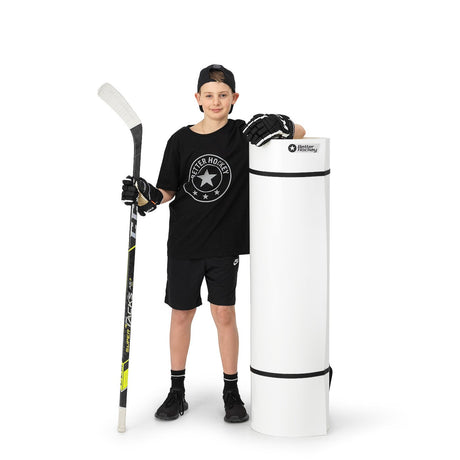
- Moving release: 3×10 walking shots on a longer surface — pull, shoot mid-stride, hit the call. A roll-up pad gives you the runway.
Coach Erik's tip: Don't panic when your hit rate halves under time pressure — I see it with every group I train, and it's the sign you're finally practicing something new. Hold the speed and let accuracy climb back up over two or three weeks; slowing back down just re-rehearses what you already own.
Common mistakes
- Shooting at the net instead of a spot. The net always "catches" your shot, so you learn nothing. Fix: no session without targets, no shot without a call.
- Looking at the puck at release. You hit what you look at. Fix: eyes pick the target before the shot and stay there through release.
- Follow-through dies early. Cutting the finish short sprays shots. Fix: blade finishes pointing at the called corner, hold it for a count.
- Only training your money corner. Every shooter I coach has a favorite (usually low glove). Fix: fixed rotations and random calls expose the weak spots.
- Adding speed too early. Fast and wild just grooves misses. Fix: earn 50% standing accuracy before quick-release combos.
- No written score. Memory always flatters you. Fix: whiteboard by the net — date, drill, hits.
FAQ
What accuracy percentage is good for a hockey player?
On 4–6 inch corner targets from 12–15 feet, hitting 50% of called shots is strong for a youth player and 65–70% approaches elite. Most untrained players start around 20–25%, so there's fast early progress.
Should I aim for corners in a real game?
Aim for the open gap, which is usually a corner — but 2–3 inches inside the post, not paint-scraping perfect. A shot that misses the net entirely is a turnover; trained shooters build an automatic small safety margin.
How many accuracy shots should I take per day?
30 called-target shots as a dedicated block is the core dose, inside a 100-shot session. More than 50 pure accuracy reps a day tends to get sloppy — precision needs full attention on every shot.
Do shooting targets actually work?
Yes, because they change what you practice: instead of rewarding any shot that goes in the net, they only reward shots in the scoring zones. Players who train with targets for 6–8 weeks typically double their called-shot hit rate.
Is it better to shoot hard or accurate?
Accurate first, then hard. A 50 mph shot inside the post scores; a 70 mph shot into the goalie's chest doesn't. Build 50%+ accuracy at moderate power, then add velocity back gradually while keeping the hit rate above 40%.
How do I train accuracy without a net?
A goalie-print shooting tarp with target holes hangs in a garage doorway and does the same job — the open zones are the targets. Even taped squares on a wall work for foam-ball training, though a net with real targets gives the best feedback.
Summary
Shooting accuracy is a system: five scoring zones, a target in each, a call before every shot, and a score after every session. Run the 8-week shrinking-target progression, keep the games competitive, and only add quick-release pressure once your standing hit rate clears 50%. The net result — literally — is a player who picks gaps under pressure instead of feeding the goalie's logo.
Round out your shooting: fix the mechanics in how to improve your wrist shot, load your week with the best shooting drills, and build the reps at home with shooting practice at home. Everything else lives in the shooting library.