Quick answer
The best hockey shooting drills combine a specific target, a set rep count, and a score you track. Beginners should master stationary wrist shots and corner calls (100 shots a day), intermediate players add quick-release, one-timer, and in-motion drills, and advanced players train under time pressure with games like Around the World and 21. All 12 drills below work off-ice on a shooting pad — you need a net, four corner targets, and 15–25 minutes.
Key takeaways
- Every drill needs three things: a defined target, a rep count, and a score you write down.
- Progress in order: stationary technique → quick release → shooting in motion → shooting under pressure.
- Corner targets turn lazy net-shooting into deliberate practice — aim at something 4 inches wide, not something 6 feet wide.
- 100 shots per session, 5–6 sessions a week, is the volume that separates improving players from stagnant ones.
- Accuracy games (Around the World, 21, Beat the Clock) keep high-volume training fun enough to sustain.
What you need for these drills
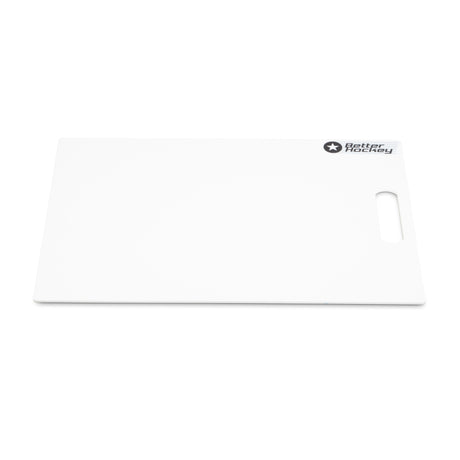
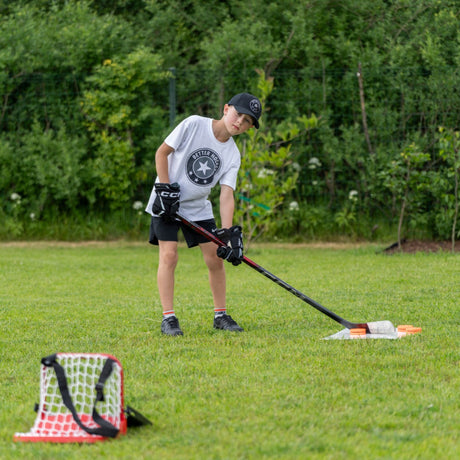
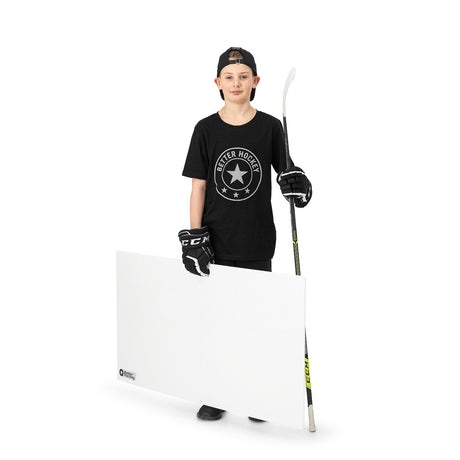
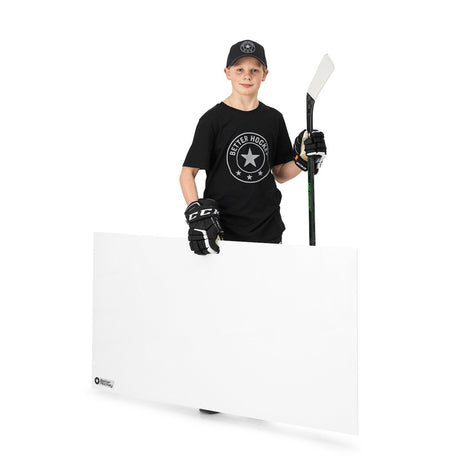
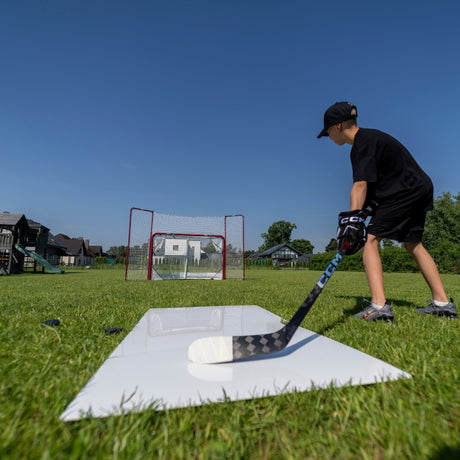
A shooting pad or training tiles, 10–20 pucks, a net, and corner targets. Hanging shooting targets cover the four corners; XDT smart targets add automatic hit tracking through an app, which makes the scored games below effortless to run. If you shoot full power outdoors, put a shooting tarp behind the net.

Beginner shooting drills (first 1–2 seasons)
- Stationary wrist shots. 3×20 shots at 70% power. Puck starts behind the back foot, rolls heel to toe, follow-through points at the net. Standard: 15 of 20 on net where you aimed. Full technique details in our wrist shot guide.
- Four corners. 40 shots, 10 at each corner target, always in the same order (low glove, high glove, low blocker, high blocker). Score: hits out of 40. Most beginners I test start around 8–12; get to 20 before moving on.
- Forehand–backhand alternate. 2×20 shots alternating forehand and backhand from 10 feet. Builds the backhand most young players skip. Standard: 10 of 20 backhands on net.
- Follow-through freeze. 20 shots; hold the finish for 2 full seconds after every shot and check the blade points at your target. Cue: "blade tells the truth." A form drill — no score, just honesty.
Coach Erik's tip: Follow-through freeze is the drill every beginner wants to skip and the one that fixes the most. The error I see constantly is a blade pointing a foot wide of the target on the finish — the player never notices until they're forced to hold it and look.
Intermediate shooting drills (comfortable technique, needs speed)
- Quick-release snap shots. 4×10 shots with zero wind-up — puck touches the blade and leaves in under one second. Watch for: hands drifting back into a wind-up — that's the habit this drill exists to kill. Score: on-target hits out of 40. Deep dive: quick release training.
- Catch and shoot. 3×10: toss the puck out of your reach, control it, and shoot within one second of settling it. Simulates receiving a pass in the slot. Play it heads-up: eyes find the target before the puck arrives, glance down only to settle it. Standard: 6 of 10 on target.
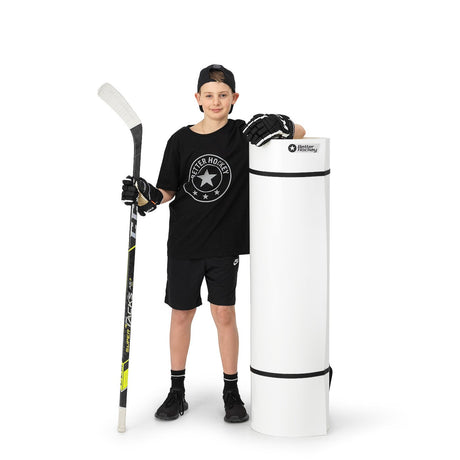
- Walking wrist shots. 3×10 shots while moving forward — pull the puck into shooting position mid-stride and fire without stopping. On a longer surface like a roll-up shooting pad you get 8.5 feet of runway.
- Toe-drag release. 3×10: drag the puck around an obstacle (glove or cone), then release immediately. Changes the shooting angle the way a defender's stick would.
Advanced shooting drills (game-speed training)
- Around the World. Hit all four corner targets in order, counting total shots needed. Par for advanced players is 8–10 shots; elite shooters do it in 5–6. Three rounds, log every score.
- 21. Low corners = 1 point, high corners = 2, five-hole = 3. First to exactly 21 wins — go over and you reset to 15. Brutal for accuracy under pressure, perfect head-to-head with a training partner.
- Beat the Clock. 60 seconds, unlimited pucks, count target hits. Rushing destroys mechanics — this drill teaches you to be fast and clean. Advanced standard: 8+ hits per minute.
- Speed ladder. 10 shots at maximum power measured with a shot speed radar, then 10 accuracy shots at 80%. Alternating power and precision blocks trains you to dial effort up and down. Track your top speed weekly; 10 reps with a heavy puck before the radar block builds shot-specific strength.
Coach Erik's tip: When an advanced drill stops being hard, shrink the space instead of adding shots — pull the targets tighter into the corners, move a stride closer to cut your angle, or take a step of runway away. A smaller window forces the quicker hands you're actually training for.
Drill progression table
Use this as a season-long roadmap. Move up a level when you hit the exit standard three sessions in a row.
| Level | Core drills | Session volume | Exit standard |
|---|---|---|---|
| Beginner | Drills 1–4 | 100 shots, 15–20 min | 20/40 in Four Corners; 15/20 stationary on target |
| Intermediate | Drills 2, 5–8 | 100–120 shots, 20 min | 25/40 quick-release on target; clean release in motion |
| Advanced | Drills 5, 9–12 | 120–150 shots, 25 min | Around the World in 8 or fewer; 8+ hits in Beat the Clock |
Accuracy games that keep you shooting
Volume only happens when training is fun — that's why I end every session I run with one of these games. Three that work solo or with a partner:
- HORSE for shooters: one player calls and hits a shot (corner + shot type); the other must match it or take a letter.
- Ten in a row: pick one target, count consecutive hits. A miss resets to zero. Simple and weirdly addictive.
- Progressive distance: hit a target from 10 feet, step back 3 feet, repeat. Your "range record" is the distance where you can still hit 2 of 5.
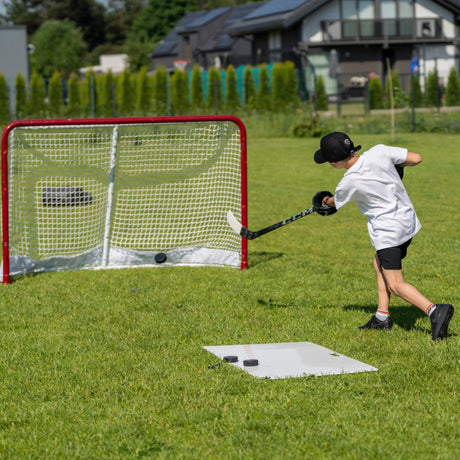
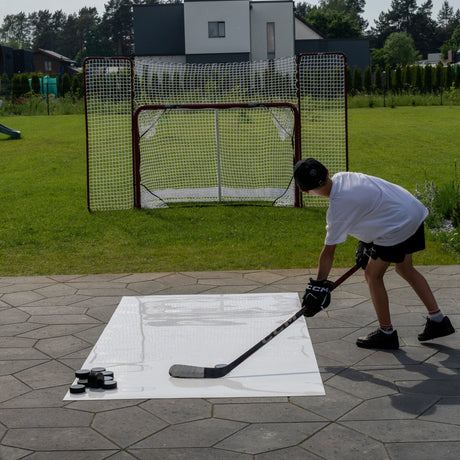
Here's what structured target shooting looks like in practice:
Common mistakes
- Shooting at "the net." A net is a 24-square-foot target — you can't miss, so you can't improve. Fix: always aim at a corner target or a specific spot.
- Skipping levels. Quick-release drills with sloppy mechanics just automate bad habits. Fix: meet the exit standard before moving up.
- Never counting. If you don't score the session, you can't see progress. Fix: one number per session, written down — hits, time, or shots-to-complete.
- Same drill every day. Your body adapts and stops learning. Fix: rotate 3–4 drills per session from your level.
- Only shooting from your comfort spot. Games happen from bad angles. Fix: move the pad or change your position every set.
- Full power all the time. Power without control is turnovers. Fix: keep roughly 70% of your reps at controlled speed.
FAQ
How many shots should I take per training session?
100 shots in 15–25 minutes is the benchmark for players 10 and up. Split them into 3–4 drills with a score, rather than firing them all mindlessly. Kids under 10 do better with 25–50 shots in game format.
What is the best shooting drill for beginners?
Four Corners: 40 shots, 10 at each corner target, in a fixed order. It builds aim, forces both high and low releases, and gives you a score out of 40 you can beat next session.
Can I do these shooting drills without ice?
Yes — all 12 drills are designed for off-ice training. A shooting pad or training tiles give the puck ice-like glide, and a net with corner targets completes the setup in a garage, driveway, or backyard.
How often should I do shooting drills?
5–6 short sessions a week beats 1–2 long ones. Skill is built by frequency: 100 shots a day is roughly 3,000 a month, which is more than many players take in a full season of team practices.
What are hockey shooting targets and do I need them?
They're corner-mounted targets that hang in the net where goals actually get scored. They matter because aiming at a 4-inch target trains precision that aiming at an open net never will. Smart versions track your hits automatically via an app.
At what age can kids start structured shooting drills?
Around age 7–8 for short, game-based versions (Ten in a Row, knock-down targets), and age 10+ for the full progression with rep counts and standards. Keep sessions under 15 minutes for young kids.
Summary
Twelve drills, three levels, one rule: every shot needs a target and every session needs a score. Start at your honest level, hit the exit standard three sessions running, and move up. With 100 shots a day on a proper surface, the progression table above is a full season of shooting development in one page.
Keep building: perfect your mechanics with the wrist shot guide, set up your space with shooting practice at home, and sharpen your aim with shooting accuracy training. More in the shooting library.