Quick answer
The 10 most common hockey shooting mistakes are: starting the puck too far forward, shooting with arms only (no weight transfer), gripping the stick too tight, wrong bottom-hand position, no heel-to-toe roll, stopping the stick at release, shooting off the wrong foot, aiming at the goalie instead of the opening, never practicing with targets, and training at random without tracking results. Fix them in that order and most players add 10–20 mph and significant accuracy within 6–8 weeks of focused work.
Key takeaways
- Most missed shots trace back to one of three root causes: wrong puck position, no weight transfer, or a death grip on the stick.
- The heel-to-toe roll is the one mechanic that separates a wrist shot from a push — if the puck wobbles, this is why.
- Follow-through is not optional — stopping the stick early is the fastest way to kill both power and accuracy.
- Aiming at the goalie is the single biggest in-game mistake. Aim at the openings, not the person.
- Random practice builds random results. Track accuracy and speed every session to see real progress.
- Self-diagnosis is faster with a phone camera. Five seconds of side-angle video tells you more than an hour of guessing.
The 10 mistakes — with fixes and drills

At Better Hockey Academy camps, these are the errors Coach Erik sees most often — usually in this order of frequency. Work through the table, diagnose which ones apply to your shot, and use the targeted drill to fix each one.
| Mistake | Symptom | Fix | Drill |
|---|---|---|---|
| 1. Puck starts too far forward | Weak shot, no power buildup | Start puck behind back foot, on the heel of the blade | Tape a line 6 inches behind your back foot; puck must start behind it on every rep |
| 2. Shooting with arms only | Shot plateaus, sore arms, poor power | Drive back leg into front — weight transfer creates 50%+ of power | Exaggerated weight-transfer drill: back heel lifts at release, 3×15 reps |
| 3. Death grip on the stick | Stiff shot, slow release, blade twist at contact | Firm bottom hand, relaxed top hand; if knuckles are white, loosen | Shoot 10 reps with top hand gripping only with 3 fingers; feel the release speed increase |
| 4. Bottom hand too high | Low shot power, stick hard to flex | Bottom hand ~halfway down shaft for wrist/snap shot; higher for slap wind-up | Mark shaft with tape at correct position; check before every practice block |
| 5. No heel-to-toe roll | Puck wobbles in air, poor accuracy | Roll puck from blade heel to toe on every shot — that spin makes it fly flat | Slow-motion reps at 30% power; count 3 full seconds per shot until roll is obvious |
| 6. Early stick stop | Power loss, random direction | Follow through completely; blade points at target after every shot | Hold finish for a 2-count after each shot; coach or phone camera checks the pose |
| 7. Shooting off wrong foot | Awkward body position, low power | Left-shot: left foot forward at release; right-shot: right foot forward | Practice stationary shots with exaggerated foot position before adding movement |
| 8. Aiming at the goalie | Most shots stopped, no scoring instinct | Pick a corner or opening before you receive the puck, not after | Call your corner aloud before every shot in practice; 25 shots, track hit rate |
| 9. Never training with targets | Accurate on empty net, misses with targets in | Use corner targets every session — aiming at a specific object is a trainable skill | Hang shooting targets in all 4 corners; shoot 10 per corner per session |
| 10. No tracking or structure | Months of practice, little improvement | Log accuracy (hits/25) and how the shot felt every session | Run timed blocks: 10 min technique, 10 min accuracy, 5 min game-simulation |
Coach Erik's tip: At my camps the single quickest fix is always the same: put the phone on a tripod, shoot 10 shots, and watch the video. Players who think they're doing everything right usually spot 3 mistakes in the first viewing. Self-diagnosis with video costs you 5 minutes and saves weeks of confused practice.
How to diagnose your own shot
You don't need a coach present to identify which mistakes are in your shot. This self-diagnosis checklist takes about 10 minutes.
- Film from the side. Set your phone at hip height, 6–8 feet to your non-shooting side. Shoot 10 wrist shots at full speed. Watch back at 0.25x speed.
- Check puck start position. Where is the puck at the first frame? If it's level with your front foot, that's mistake #1.
- Watch your back foot. Does it stay flat until release? If yes, there's no weight transfer happening (mistake #2).
- Look at your arms in wind-up. If both elbows are pressed to your sides with no movement between them, you're arm-shooting (also mistake #2).
- Watch the puck in the air. Does it wobble or spiral? No heel-to-toe roll (mistake #5).
- Check the follow-through. Where does the stick stop? Blade should point at your intended target — if it stops at hip level, that's mistake #6.
- Accuracy block. Hang two targets in the top corners. Call each corner before you shoot. Track: hits out of 10 per corner. Below 4/10 per corner = targeting problem.
Film yourself again after 3 weeks of focused work on the mistakes you found. The before/after comparison is the best motivation tool available.
Coach Erik's tip: When a player comes to me saying their shot "just doesn't feel right," I ask one question first: which corner are you aiming for? If they can't tell me before they shoot, we've already found the biggest problem. Precision starts before the puck moves — pick your spot first, every single rep.
The camp observations: what I see most often by age group
Certain mistakes cluster by age. Knowing which ones are common at your level helps you prioritize.
| Age group | Most common mistake | Second most common | Priority fix |
|---|---|---|---|
| 8–10 (Mite/Atom) | Puck too far forward | No heel-to-toe roll | Slow-motion technique reps before any speed work |
| 11–13 (Peewee) | Arm-only shooting | Death grip | Weight-transfer drill with exaggerated back heel lift |
| 14–16 (Bantam/Midget) | Aiming at the goalie | Early stick stop | Call-the-corner drill, 25 reps per session |
| 17+ / Adult | No training structure | Wrong stick flex for body weight | Block-based routine, log accuracy numbers every session |
Building the fix into daily practice
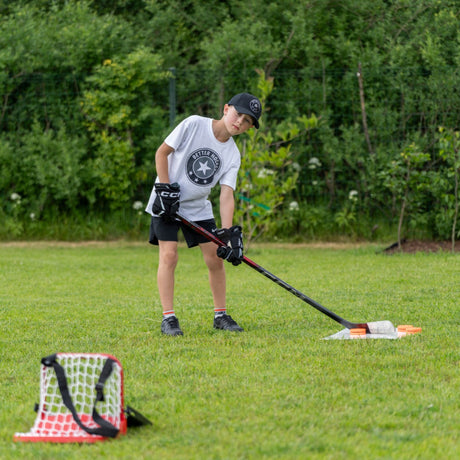
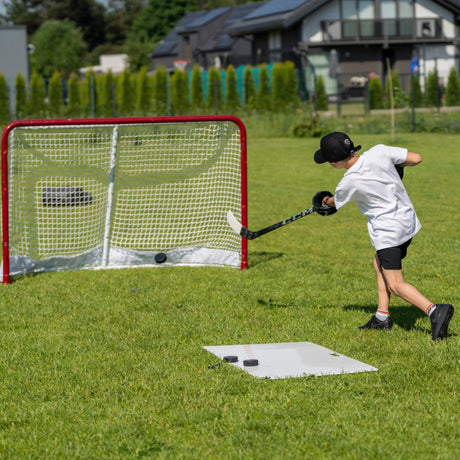
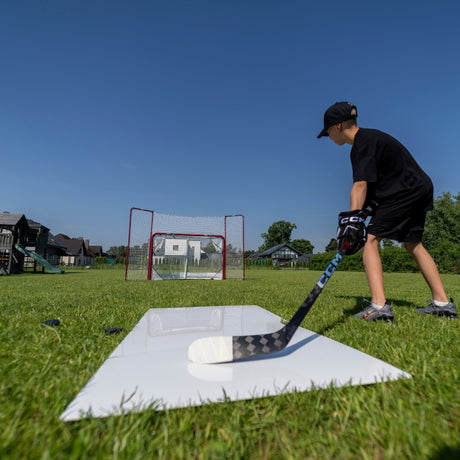
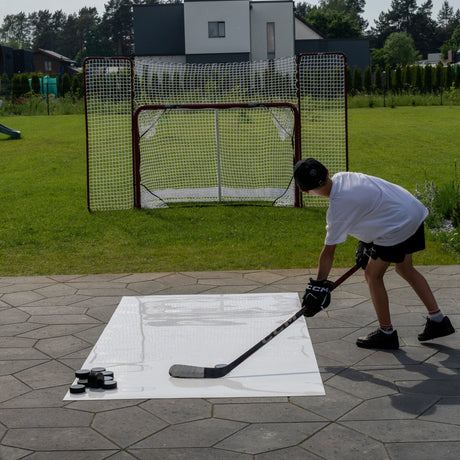
Identifying a mistake means nothing unless you have a structured way to replace it. Here is the 20-minute block format I use at camps to build correct mechanics fast. Do this 5 days a week on a shooting pad — the consistent surface is essential because random surfaces (carpet, concrete, grass) change how the puck behaves and confuse your feel.
- Warm-up (5 min): 20 slow-motion reps focusing only on your #1 diagnosed mistake. Zero power. Count each one.
- Technique block (8 min): 40 reps at 70% power. Hold your follow-through for 2 seconds after every shot. If puck wobbles in air, stop and go back to slow-motion until spin returns.
- Accuracy block (5 min): 25 shots with corner targets hung. Call corner before every shot. Write down: hits out of 25.
- Game block (2 min): 15 quick shots off the move — pull puck from the side and fire without setting up. Your only job: release is on time.
For additional structured volume, see our best hockey shooting drills guide and the how to practice hockey shooting at home setup guide.
Common mistakes
- Trying to fix everything at once. Pick one mistake per week. Fixing two mechanics at the same time usually causes regression in both. Fix: work down the table one row at a time.
- Practicing too fast. Speed hides mistakes rather than fixing them. Fix: slow-motion reps at 30% speed until the new pattern is automatic — that usually takes 3–5 sessions of 20+ slow reps.
- Using the wrong surface. Carpet or concrete won't give you the glide feedback needed to feel the heel-to-toe roll. Fix: use a shooting pad — consistent surface, consistent feedback.
- Skipping video review. Perceived mechanics rarely match actual mechanics. Fix: film at least once a week and compare to the self-diagnosis checklist above.
- Training without a target. An empty net develops zero corner accuracy. Fix: always train with shooting targets so you're aiming at a specific point, not just "the net."
FAQ
Why is my wrist shot weak even though I practice a lot?
Volume without technique fixes the wrong problem. The two most common power killers are starting the puck too far forward (short runway) and no weight transfer from back leg to front. Check both on video before adding more reps. See also our full wrist shot technique guide.
How do I stop aiming at the goalie?
Pick your corner before the puck arrives on your blade, not after. In practice, call it aloud every rep — "top glove," "short side low" — and track your hit rate. This is a habit, not a natural instinct, and it takes 2–3 weeks of deliberate targeting to become automatic.
Why does my puck wobble in the air?
The puck isn't rolling heel to toe on the blade. It's either starting too far forward (no runway) or you're pushing it rather than rolling it. Slow your shot to 30% speed and watch the blade carefully — you should see the puck travel from heel to toe before it leaves the stick.
What is the correct bottom-hand position for a wrist shot?
Roughly halfway down the shaft — low enough that the stick can flex but high enough that you can push-pull cleanly. If your bottom hand is in your stickhandling position (high), you lose both power and flex. Mark the shaft with tape once and check it before every session until the position is automatic.
Should I use a heavier puck to fix shooting mistakes?
Only after your technique is clean. A heavier puck amplifies whatever pattern you have — if your pattern is wrong, heavy pucks reinforce the mistake. Fix mechanics first with a regular puck, then add heavy pucks in short blocks (10–15 reps) once 70% of your shots are technically sound.
How long does it take to fix a shooting mistake?
A single mechanical error typically takes 2–3 weeks of daily focused work to replace — about 20 correct reps per session, 5 days a week. The new pattern takes that long to become automatic under game-speed conditions. Trying to rush by adding power before the mechanics stick usually resets the clock.
Summary
Most hockey shooting problems come from a short list of fixable mechanics: puck position, weight transfer, grip tension, heel-to-toe roll, follow-through, and a lack of deliberate targeting. Film your shot, run through the self-diagnosis checklist, identify your top one or two mistakes, and fix them one at a time with structured daily reps. Track your accuracy numbers every session — improvement you can measure stays.
Next steps: dive deeper into mechanics with our wrist shot technique guide, work on precision with our shooting accuracy guide, or explore all shooting guides.