Quick answer
A daily hockey training routine takes 25 minutes and covers three blocks: 8 minutes of stickhandling, 12 minutes of shooting (75–100 shots), and 5 minutes of explosive movement. Run it 6 days a week, any time of day, in a driveway or garage. This structure — already referenced in the at-home training guide — is the minimum effective dose for off-ice skill development. Consistency matters far more than session length.
Key takeaways
- 25 minutes daily, 6 days a week equals roughly 130 hours of deliberate skill work per year — more than most players get from team practice alone.
- Three blocks in sequence: stickhandling first (fresh hands), shooting second, explosive movement last.
- Morning sessions favour habit-building; evening sessions can leverage post-practice energy but need a clear wind-down.
- School-day version (25 min) and weekend version (45 min) keep the routine sustainable across the week.
- Habit-building requires an anchor — attach the session to something that already happens daily (after school, after dinner) rather than trying to "find time."
- Track one number per session: accuracy-block hits. Over 4–6 weeks, this number rising is the proof that the routine is working.
The 25-minute daily training template
| Block | Time | Activity | Goal |
|---|---|---|---|
| Stickhandling | 8 min | 3 min stationary pattern work → 3 min moving through cones → 2 min eyes-up speed | Build puck feel and hand speed |
| Shooting | 12 min | 20 technique shots (70% power) → 30 accuracy shots (call corners) → 25 quick-release shots → final 5 game-situation shots | Build shot mechanics, accuracy, and release speed |
| Explosive movement | 5 min | 3×5 broad jumps or lateral bounds, or 4×10-second speed bursts | Maintain fast-twitch output and skating power |

Block 1: Stickhandling (8 minutes)
Start every session with your hands. Hands are a skill — they need to be warm before you ask them to perform under pressure. Cold stickhandling produces sloppy touches that reinforce bad habits.
- Minutes 1–3: Stationary pattern work. Forehand-backhand in tight, figure-8 around a ball, toe-drag curl. Slow enough that you feel every touch. Use a stickhandling trainer for consistent ball return and varied height challenge. Cue: "soft hands, feel the ball through the blade."
- Minutes 4–6: Moving through cones. Set up 4–6 cones in a line or zigzag pattern. Stickhandle through at increasing speed. Change direction every 30 seconds. This is where you practice handling while your feet are moving — the condition that actually matters in games.
- Minutes 7–8: Eyes-up speed. Max-effort forehand-backhand with your eyes fixed on a point on the wall or fence — not on the ball. If you have to look down to keep control, slow down until you don't. Watch for: the bottom hand gripping too tight under fatigue — it kills feel exactly when you need it most.
For players who want a more challenging stickhandling tool, the Stickhandling Trainer Pro has adjustable height and multiple ball positions that force variable angles. The Game Changer stickhandling ball has a weighted core that builds wrist resistance while maintaining a game-realistic feel.
Block 2: Shooting (12 minutes, 75–100 shots)
Twelve minutes of focused shooting produces 75–100 shots. That volume, done daily, equals 500–700 shots per week — more than most players take in a month of team practices. The key is not the number; it is the structure within the number.
- 20 technique shots (4 min). Slow down to 70% power. Focus only on mechanics: puck starts behind your back foot, heel-to-toe roll, weight transfer, follow-through pointing at the target. Do not count these toward accuracy. They are the warm-up for your shot, not the shot itself.
- 30 accuracy shots (5 min). Full-effort wrist shots, but call the corner before every one. Top left, low right, mid-blocker side — say it out loud, then shoot. Count your hits. This is the number you track and try to improve each session. Use shooting targets hung in corners for a real aiming point.
- 25 quick-release shots (2 min). Pull the puck from your side, shoot without a wind-up. The goal is time from touch to release — under 1 second. Simulate the puck arriving from a pass: reach, settle, shoot. No setup, no adjustment.
- 5 game-situation shots (1 min). These are whatever you choose: a backhand you need to improve, a one-timer from a feed, a shot off a tight-angle pull. One shot type, 5 reps, maximum focus.
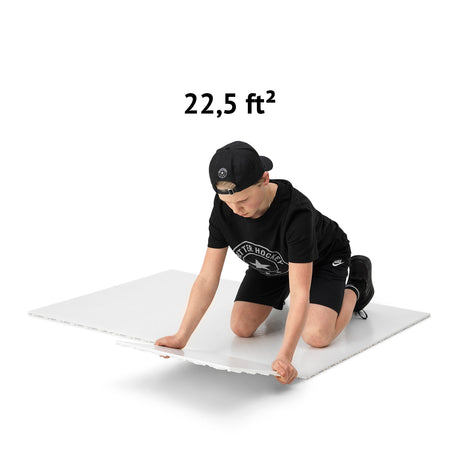
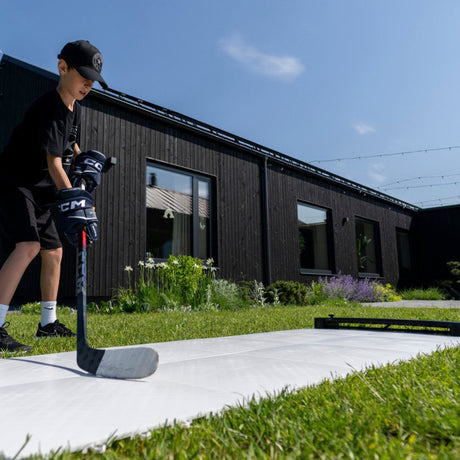
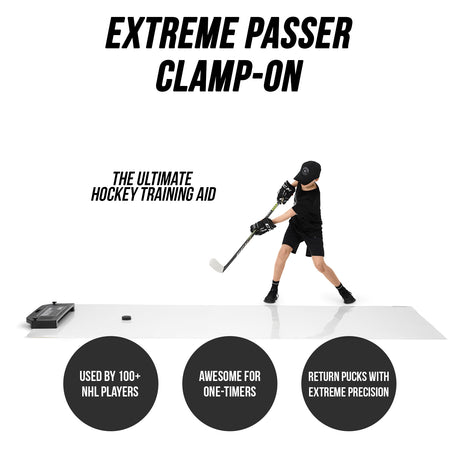
You need a smooth surface to get the puck moving realistically. Any shooting pad works — the standard 24"×48" pad is enough for the 25-minute routine. If you are regularly pulling pucks from wide angles or doing pass-and-shoot sequences, the Pro pad gives you more working space.
Coach Erik's tip: The accuracy block is the most important block in this routine. Most players I train shoot a lot but never call their shots — they shoot at "the net" and are surprised when they can't place the puck under game pressure. Calling the corner before every rep is uncomfortable at first. Within two weeks it becomes automatic, and your shot placement under pressure improves measurably.
Block 3: Explosive movement (5 minutes)
Five minutes of explosive movement at the end of every session keeps your fast-twitch fibres firing year-round without requiring a separate workout. Pick one exercise per day and do it with full effort — these are not conditioning reps, they are power reps. Full recovery between reps.
| Day | Exercise | Sets × Reps | Hockey carryover |
|---|---|---|---|
| Monday | Broad jumps | 3×5 | Horizontal push power = skating stride |
| Tuesday | Lateral bounds (single-leg) | 3×6 each leg | Crossover push power |
| Wednesday | 10-second speed bursts | 4×10 sec max | First-step acceleration |
| Thursday | Box jumps or vertical jumps | 3×5 | Explosive hip extension |
| Friday | Lateral bounds | 3×6 each leg | Crossover power (repeat — most hockey-specific) |
| Saturday | Sprint start into deceleration | 5×5 sec burst, stop hard | Acceleration and edge control |
Morning vs evening: which is better?
The best time to train is the time you will actually do it consistently. That said, there are real differences:
- Morning sessions: Before school, before the day fills up — nothing can cancel them. Lower body temperature means a longer warm-up is important. Skill acquisition may be slightly lower than evening, but habit consistency is typically higher for players who choose morning.
- Evening sessions: Body temperature is naturally higher — the warm-up phase is shorter and hands feel more ready. Better for quality skill work. Risk: fatigue from school or practice competes with motivation, and screens before bed after a high-energy session can hurt sleep.
Most players I work with who build a lasting daily habit do it in the evening — right after dinner, before homework gets long. The exact time matters less than the anchor. Attach the session to something that already happens: after dinner every night, not "when I have time."
School-day version vs weekend version
| Version | Total time | Stickhandling | Shooting | Explosive | When to use |
|---|---|---|---|---|---|
| School-day (standard) | 25 min | 8 min | 12 min (~80 shots) | 5 min | Mon–Fri during school weeks |
| Weekend (extended) | 45 min | 15 min | 20 min (~120 shots) | 10 min | Sat–Sun or any day without school |
| Minimum (game-day or tired) | 10 min | 5 min (stationary only) | 5 min (25 shots — technique only) | Skip |
The minimum version matters. Players skip sessions entirely when life gets in the way because they feel the full 25-minute version is the only valid option. Ten minutes of clean stickhandling and 25 technique shots is far better than zero. Protect the streak — 10 minutes counts.
Coach Erik's tip: I tell my players to put their stick and shooting pad by the back door before they go to sleep. When you see it in the morning or after school, the decision is already made. Environmental design beats motivation every time. The stick by the door is worth more than the best training plan that lives in a notebook.
Habit-building: making the routine stick
The routine is simple. Making it a true daily habit is the harder part. Three things that work:
- Anchor it. Pair the session with an existing habit: after dinner, after school drop, after waking up. "I train after dinner" is a decision made once. "I train when I find time" is a decision made — and often skipped — every day.
- Track one number. Write down your accuracy-block hits after every session (out of 30 called shots). When that number rises over 6 weeks — and it will — you have visible proof the routine is working. Visible progress is the most powerful motivator there is.
- Use the minimum version. Never skip entirely — do the 10-minute minimum. Streaks are broken by the first miss, and streaks produce results. The minimum version is there precisely for travel days, game days, and tired days.
Common mistakes
- Shooting without a pad. Grass and concrete don't let the puck slide — you are training a different motion from ice. Fix: use a shooting pad for all shooting reps.
- Stickhandling while looking down. Every rep where you look at the puck reinforces that habit for games. Fix: pick an eye-level focal point and force eyes-up from minute 1.
- Skipping the explosive block. It's only 5 minutes and easy to cut when you're tired. Fix: do it first on tired days. Five minutes of jumps takes less energy than you think and the neurological benefit compounds over months.
- No structure within the shooting block. Firing 80 shots at "the net" without calling corners or tracking accuracy. Fix: follow the 4-block shot structure every time.
- Inconsistent timing. Training at a different time every day makes the habit fragile. Fix: same time, same anchor, every day.
FAQ
How long should a daily hockey training session be?
25 minutes is the minimum effective dose for meaningful skill development. The 25-minute template covers stickhandling, shooting, and explosive movement with enough volume in each block to produce real improvement. Longer on weekends (45 min) accelerates the gains. Shorter on busy days (10 min minimum) preserves the habit.
Should I train every day or take rest days?
Six days per week with one full rest day is the standard recommendation. The rest day allows connective tissue and neural recovery. If you have on-ice practice or games, those count as training days — adjust the off-ice session to the minimum version on heavy days.
Is it better to train in the morning or evening?
Evening is slightly better for skill quality because body temperature is higher and hands feel more ready. But morning works if that is when you will actually do it consistently. The best time is the time you protect every day — not the theoretically optimal time that gets skipped.
How many shots should I take daily?
75–100 focused shots per day is the target for the 25-minute routine. Quality over raw count: 80 shots with called corners and tracked accuracy beat 150 careless shots every time. Young players (under 10) can start at 25–40 shots per day.
Can I do this routine on game days?
Use the 10-minute minimum version on game days: 5 minutes stationary stickhandling and 25 technique shots at 70% power. This keeps the habit alive and serves as a game-day skill warm-up without adding fatigue.
What equipment do I need for the 25-minute daily routine?
A shooting pad, a stick, 3–4 pucks, and a surface to stickhandle on. A stickhandling trainer and drill cones are useful additions. Shooting targets add an aiming point that measurably improves accuracy. All of it fits in a garage or driveway.
Summary
The 25-minute daily training routine — 8 minutes stickhandling, 12 minutes shooting, 5 minutes explosive movement — is the most important off-ice habit a hockey player can build. Run it 6 days per week, track your accuracy-block hits, and use the 10-minute minimum on days when the full session is not possible. Protect the streak; the streak produces the results.
See the full at-home training guide for how to structure a complete home setup, the weekly off-ice program for how the daily routine fits into a full training week, and the tryout preparation plan for how to intensify the routine in the 4-week window before tryouts. All guides are in Hockey Training.