Quick answer
In-season hockey training is about maintenance, not maximum gains. The goal is keeping the skills, strength, and conditioning you built in the off-season while managing the fatigue that comes from games, practices, and school or work. For most youth players, 2–3 short off-ice sessions per week of 15–25 minutes each is enough. On a game week, cut volume by half and skip anything that leaves your legs sore the day before you play.
Key takeaways
- The in-season goal is skill and fitness retention — not building new fitness. Trying to peak during the season leads to burnout and injury.
- 15-minute skill sessions 3–4 times per week beat one long session. Frequency keeps skill patterns sharp; length exhausts recovery.
- Game weeks: reduce volume, keep intensity. No heavy lifting the day before or after a game.
- Signs of overload in youth players: declining grades or mood, soreness that doesn't clear in 48 hours, loss of enthusiasm for the game.
- Sleep is the most powerful recovery tool available — 9–10 hours for players 8–14, 8–9 hours for ages 15–18.
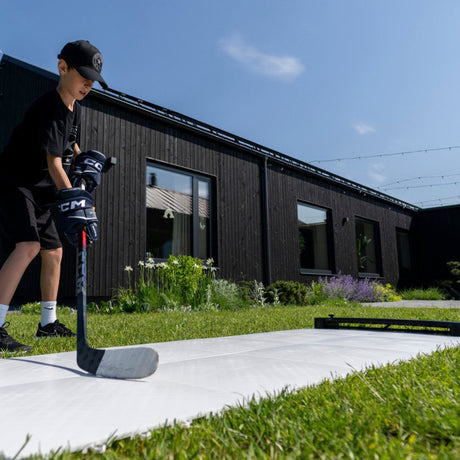
- Stickhandling and shooting skills can be maintained in a small space in under 20 minutes a day.
Why in-season training is different
Off-season training is progressive — you add load, increase reps, push new limits each week. In-season is the opposite. Your game schedule creates its own training stimulus. Two or three on-ice sessions and 1–2 games per week is already a significant athletic workload for a developing player. Adding heavy off-ice training on top of that is a fast path to burnout, not development.
Most players I work with arrive at the end of a season slower, less sharp, and more tired than they were in October — not because they stopped training, but because they kept adding work without managing recovery. The smartest thing a motivated player can do in November is train less than they did in August, while keeping the quality high.
The 15-minute maintenance session model

A 15-minute session done 3–4 times per week touches the skills that matter most without creating accumulated fatigue. The structure is simple:
- 3–4 minutes: Dynamic warm-up — leg swings, hip circles, 2 short acceleration runs.
- 8–10 minutes: Skill work — stickhandling, shooting, or passing. One skill per session, focused reps.
- 2–3 minutes: Cool down — light stretch of hip flexors, hamstrings, and thoracic spine.
That is it. Fifteen minutes, done consistently, keeps your hands sharp, your shot grooved, and your eye-hand coordination calibrated — all things that fade rapidly when you go dormant for a 7-day stretch between ice times.
Coach Erik's tip: The most important word in in-season training is "focused." I've seen players spend 45 minutes in the driveway during the season and come out worse than before because they were just killing time, not training. Fifteen minutes with intent — a specific skill, a specific drill, tracking how many out of 10 they hit — is worth three times a passive long session.
Game week vs. off week: what to train
| Week type | Session length | Best focus | Avoid |
|---|---|---|---|
| 1 game week | 15–20 min, 3× | Stickhandling, shooting technique, light skating | Heavy legs, plyometrics day before game |
| 2 game week | 12–15 min, 2× | Skill touch — 1 drill per session only | Any new training stress; save energy for games |
| 3+ game week (tournament) | 10 min max, 1× | Light movement, stretch, sleep | All off-ice training intensity |
| Off week (no games) | 20–30 min, 3–4× | Full skill session + light conditioning | Trying to peak; keep intensity moderate |
Cue for game week: "Sharpen, don't tire." Every session should leave the player feeling the same or better than when they started — never depleted.
Skills that need weekly touch to stay sharp
Some skills decay fast without repetition. Others hold well. Prioritize the fast-decaying ones during in-season maintenance:
- Stickhandling feel: Degrades noticeably in 5–7 days without reps. Even 10 minutes every other day on a Game Changer or with a stickhandling ball keeps the hands calibrated.
- Quick release: The wrist snap and timing feel of a quick release requires frequent grooved repetitions. 30–50 shots on a shooting pad every 2–3 days maintains it.
- Passing accuracy: Less volatile than stickhandling, but 10 minutes with a rebounder twice a week keeps tape-to-tape passing sharp.
- Skating mechanics: Maintained mostly through ice sessions; off-ice work with a slide board adds crossover-specific maintenance if you have one.
Load management for youth players
Youth athletes — especially 10–15-year-olds in competitive hockey — are often juggling school, on-ice practice 3–4 times per week, games, and family commitments. Off-ice training is an addition to that load, not a replacement. Before adding any session, ask: how many hours of organized sport did this player have this week? If the answer is 8 or more, recovery is the priority.
The hockey training by age group guide breaks down appropriate weekly volumes by age. General rule: under 13, total sport hours per week should not exceed the player's age in years. A 10-year-old should not have more than 10 hours of organized sport in a week.
Coach Erik's tip: Parents ask me all the time whether their kid should train more during the season. My answer is almost always: sleep more. Nine hours of sleep does more for an 12-year-old hockey player's development than any drill I can give them. When in doubt, rest wins.
Signs of overload — when to dial back
Training stress accumulates gradually and the warning signs are easy to miss. Watch for these in players of all ages:
- Muscle soreness that hasn't cleared 48 hours after the last activity
- Noticeably slower reaction times in drills that were previously easy
- Loss of enthusiasm — a player who loved practice starting to drag their feet
- Increased irritability or emotional sensitivity (in youth players this often shows up at home, not at the rink)
- Declining school performance or concentration
- Frequent minor illnesses — a sign the immune system is stressed
When two or more of these appear, cut training volume by 50% for 10–14 days. Do not try to push through. The body is signaling that recovery is overdue. Related: keeping sessions fun is one of the most underrated tools against burnout in youth players.
Sample in-season weekly plan (1-game week)
- Monday (day after game): Rest or light walk. No structured training.
- Tuesday: 15-min session — stickhandling only. 3 drills, 5 min each.
- Wednesday: Team practice (on-ice).
- Thursday: 15-min session — 40 shots on shooting pad, focus on release and accuracy.
- Friday: Light movement, stretch. Game tomorrow — no new fatigue.
- Saturday: Game.
- Sunday: Rest or light activity only.
Common mistakes
- Treating in-season like the off-season. Adding volume when games increase leads straight to burnout. Fix: when game count goes up, training volume goes down.
- Skipping maintenance entirely. Seven days without any skill work causes noticeable regression. Fix: even one 15-minute session mid-week keeps skills calibrated.
- Training heavy the day before a game. Sore legs produce a flat performance. Fix: nothing intense within 36–48 hours of a game.
- Ignoring sleep. No drill replaces 9 hours of sleep for a developing athlete. Fix: set a consistent bedtime, especially the two nights before games.
- Using in-season to fix major weaknesses. The season is for applying skills, not building them from scratch. Fix: note the weaknesses, address them in the off-season with a structured plan.
FAQ
Should players train off-ice during the hockey season?
Yes, but briefly and intelligently. Two or three 15-minute skill-focused sessions per week keep hands sharp and maintain the conditioning built in the off-season. Anything more ambitious requires careful scheduling around games and rest days.
How many days of rest does a hockey player need during the season?
At minimum one full rest day per week — ideally two. For youth players (under 14), two full rest days per week is the recommendation regardless of game count. Rest is when adaptation from training actually occurs.
Is it normal for youth players to plateau or decline mid-season?
A small dip in November or December is normal as cumulative fatigue builds. It is not normal for performance to still be declining in February. A prolonged mid-season plateau usually means insufficient recovery, and the fix is reducing training load rather than adding more.
What is the best off-ice skill to practice during the season?
Stickhandling — it decays fastest without repetition, takes the least space and time, and has no physical cost when done at skill intensity (not conditioning intensity). Ten minutes every other evening with a ball or puck on a smooth surface keeps your hands in game shape.
Can youth players build strength during the season?
A small amount of maintenance strength work — 2 sets of 5–8 reps of a few key exercises — can preserve off-season gains without adding fatigue. True strength building (progressive loading) should wait for the off-season when there is time to recover from heavier sessions.
When should in-season training intensity pick back up?
In the final 2–3 weeks before playoffs, a small taper — reducing volume but keeping or slightly increasing intensity — can help a player peak at the right time. Talk to your coach before making changes; team practice load is the primary variable.
Summary
In-season training is a balancing act: enough skill and fitness work to stay sharp, not so much that game performance and recovery suffer. Fifteen-minute focused sessions 3–4 times per week, adjusted down on heavy game weeks, is the framework that keeps most youth players performing at their best through an entire season without burnout.
For the off-season, build the base: the complete off-ice training guide and a weekly program give you the structure to arrive next season better than you left it.