Quick answer
A proper hockey warm-up before games lasts 10–15 minutes and follows a RAMP sequence: Raise heart rate, Activate muscles, Mobilize joints, Potentiate (prime the explosive system). Start with 3 minutes of light jogging or jumping jacks, move into dynamic movements — leg swings, hip circles, lateral shuffles — then add 2–3 minutes of stick-and-puck activation. Skip static stretching before games; it reduces muscle output and slows your first-step speed.
Key takeaways
- RAMP is the modern standard for pre-game warm-ups — it replaces static stretching, which science now shows is counterproductive before explosive activity.
- The optimal pre-game warm-up is 10–15 minutes — long enough to elevate body temperature and prime the nervous system, short enough not to fatigue you.
- Off-ice activation with a ball or puck builds puck feel before your first shift, so you're not "finding your hands" in the first period.
- Your body temperature drops while waiting between warm-up and puck drop — a short re-activation (10–15 jumping jacks) right before you hit the ice closes that gap.
- Static stretching belongs post-game, not pre-game.
- The full 12-minute routine below requires zero equipment and works in any arena hallway or parking lot.
Why RAMP? The science behind modern warm-ups
The old pre-game ritual — sit in the dressing room, stretch your quads and hamstrings for 10 minutes, head to the ice — is now understood to be actively harmful to performance. Static holds held for 30 seconds or more before explosive activity reduce muscle power output by 5–8% for up to 30 minutes afterward. That's your first period playing at 92–95% of your explosiveness before you've even touched the puck.
RAMP (Raise, Activate, Mobilize, Potentiate) was developed in elite sport to solve exactly this problem. It elevates body temperature, turns on the neuromuscular system, moves joints through full range dynamically, and ends with explosive movements that prime fast-twitch fibers. The result: you're physically ready from your first shift, not your second period.
Cue: "Move to warm up, don't stretch to warm up." Dynamic movement raises body temperature twice as fast as static holds.
The 12-minute pre-game warm-up routine

| Phase | Time | Exercise | Sets × Reps | Purpose |
|---|---|---|---|---|
| Raise | 0:00–3:00 | Jogging + jumping jacks alternating | Continuous | Elevate heart rate, warm muscle tissue |
| Raise | 0:00–3:00 | High knees, butt kicks | 2 × 20 m | Hip flexor activation, blood flow |
| Activate | 3:00–6:00 | Glute bridges | 2 × 12 | Turn on posterior chain before skating |
| Activate | 3:00–6:00 | Lateral band walks (or side shuffles) | 2 × 15 each | Hip abductor activation, edge work prep |
| Activate | 3:00–6:00 | Half-kneeling hip flexor stretch (dynamic) | 1 × 10 each | Hip extension range, skating stride prep |
| Mobilize | 6:00–9:00 | Leg swings front-back | 2 × 15 each leg | Hip joint mobility, stride length |
| Mobilize | 6:00–9:00 | Lateral leg swings | 2 × 15 each leg | Adductor/abductor range |
| Mobilize | 6:00–9:00 | Thoracic rotation (arm circles wide) | 2 × 10 each | Shoulder and upper back for shooting |
| Potentiate | 9:00–12:00 | Squat jumps | 2 × 6 | Fast-twitch primer, explosive first step |
| Potentiate | 9:00–12:00 | Lateral bounds (skater jumps) | 2 × 6 each | Mimics skating push, edge activation |
| Potentiate | 9:00–12:00 | Stick-and-puck / ball handling | 2 min | Puck feel, hands warm before first shift |
Coach Erik's tip: Most players skip the potentiate phase because they're already in their gear and it feels awkward to jump around the hallway. Do it anyway. The 6 squat jumps and 6 skater jumps take 90 seconds and the difference in your first-shift explosiveness is real. I've timed first-step reaction with and without the potentiate phase — the gap is measurable, not just theoretical.
Off-ice activation: hands and puck feel before you hit the ice
The last 2 minutes of your warm-up should include stick-in-hand activation. Many players walk straight from dressing room to ice and spend the first 5 minutes of warm-up "finding their hands." That's 5 minutes of useful on-ice warm-up time wasted.
Do this in the hallway or outside the rink:
- Toe-to-toe stickhandling with a ball — 45 seconds. A training ball in a hallway works perfectly. This wakes up forearm and wrist proprioception.
- Forehand-backhand quick touches — 30 seconds. Fast, light taps alternating sides. Not power, just hand speed activation.
- Mini passing against a wall — 30 seconds. If you have a wall, 10–15 quick passes. If not, solo stickhandling.
- Shooting motion without a puck — 15 seconds, 5–6 slow-motion wrist shot rehearsals feeling the heel-to-toe roll.
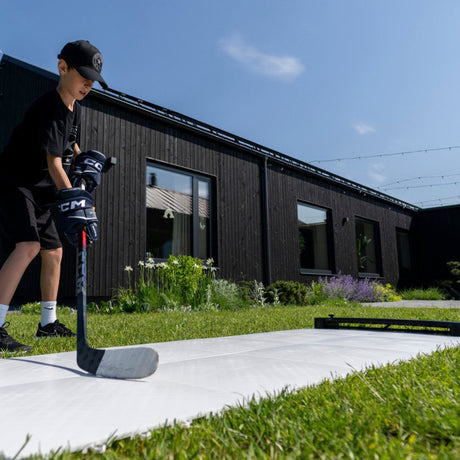
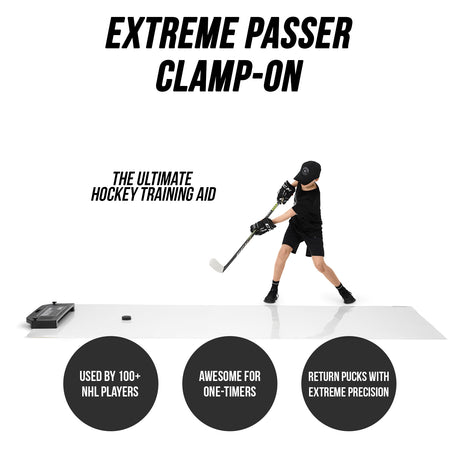
If you have time and space before the game, a shooting pad in the parking lot is the ideal off-ice activation setup. 15–20 puck shots at moderate pace, not full power, prime the shooting muscles without fatiguing them.
What to stop doing in your pre-game warm-up
| Common habit | Why it hurts | Replace with |
|---|---|---|
| Static quad stretch held 30+ seconds | Reduces quad power output pre-game | Dynamic leg swings (10–15 reps) |
| Sitting/lying down for 10 min after dressing | Body temp drops, muscles cool off | Start RAMP 15 min before puck drop |
| Groin stretch on the floor, static | Passive hold reduces hip explosive output | Walking lunges with rotation (dynamic) |
| Full-speed skating drills immediately on ice | Cold muscles + full speed = injury risk | Build speed over 3–4 laps on ice |
| Skipping warm-up entirely | First 2 periods at below-peak output | Even 5 min RAMP is better than nothing |
| Max-effort shots in warm-up | Fatigues shooting muscles before play | 70% effort shots, technique focus only |
How to re-activate when warm-up and puck drop are far apart
Teams often finish on-ice warm-up 15–20 minutes before game time. Body temperature drops noticeably in 8–10 minutes. If you go from full warm-up to sitting in the dressing room for 15 minutes, you've lost most of the benefit.
Use this 2-minute re-activation right before you head back to the ice:
- 15 jumping jacks
- 10 squat jumps
- 10 arm circles wide
- 10 stickhandling touches with a ball or stick on the floor
That's it — 2 minutes, no equipment, done in your stall. Your heart rate spikes immediately and stays elevated into the opening faceoff.
Coach Erik's tip: I tell players to think of body temperature as a fuel gauge. It takes 3–4 minutes to raise it, and it drops fast the moment you stop moving. The pre-game re-activation isn't a second warm-up — it's just re-lighting a fire that was already burning. Two minutes is all you need.
Adapting the routine for different situations
Not every game allows a 12-minute full warm-up. Here's how to scale:
- 5 minutes available: Skip the Raise phase, do Mobilize and Potentiate only. Prioritize leg swings, 4 squat jumps, 4 skater jumps, and 60 seconds of stickhandling.
- Early morning games: Add 2 extra minutes to the Raise phase — cold bodies at 7 a.m. take longer to elevate than afternoon bodies.
- Youth players (8–12): Reduce sets by half, focus on the fun movements — skater bounds are natural for kids. Keep it under 8 minutes.
- Adult recreational leagues: Full 12-minute routine applies. Most adult-league injuries happen in the first 5 minutes of games where players skipped warm-up.
For a complete weekly training structure that includes pre-practice and pre-game protocols, see our daily hockey training routine guide.
Common mistakes
- Static stretching first. It reduces power output by 5–8%. Fix: save all static holds for post-game when flexibility is the goal.
- Warming up too early. Starting your warm-up 30 minutes before puck drop and then sitting for 20 minutes undoes all the work. Fix: time your warm-up to finish 3–5 minutes before you hit the ice.
- Full-effort shots in pre-game shooting. Fatigues the shooting muscles you need in-game. Fix: 70% effort, 15–20 shots, technique focus only.
- Skipping puck activation. Walking from the locker room directly to the ice means your first 3–5 shifts are your warm-up — not your game. Fix: 90 seconds of stickhandling in the hallway before stepping on the ice.
- No potentiation. The "jump around" phase is where the fast-twitch system gets primed. Skipping it leaves first-step speed on the table. Fix: even 3 squat jumps and 3 skater bounds is enough to prime the system.
FAQ
How long should a hockey warm-up be before a game?
10–15 minutes off-ice plus the standard 15-minute on-ice warm-up most rinks allow. If you only have time for one, the off-ice RAMP routine is more important for injury prevention and early-game performance than additional on-ice stickhandling at low effort.
Why is static stretching bad before hockey?
Static stretches held for 30+ seconds tell your muscles to lengthen and relax — the opposite of what you need for explosive skating and shooting. Studies show 5–8% reduction in muscle power output lasting up to 30 minutes after static stretching. Save it for post-game recovery.
What is RAMP in hockey warm-ups?
RAMP stands for Raise heart rate, Activate muscles, Mobilize joints, Potentiate (prime explosiveness). It's the warm-up framework used by elite sport programs worldwide to replace the old static-stretch routine. It takes 10–15 minutes and leaves athletes more physically ready than any amount of passive stretching.
Should kids do the same warm-up as adults?
Same framework, scaled-down volume. Kids warm up faster than adults — 6–8 minutes of RAMP is usually enough for ages 8–14. Focus on the dynamic leg swings, a few skater bounds, and 60 seconds of stickhandling. Adults, especially over 30, benefit from the full 12-minute routine.
What if I don't have a shooting pad for pre-game activation?
Use a stickhandling ball in the hallway or parking lot — no surface required. The goal is wrist and forearm activation, not full shooting mechanics. A training ball in your hockey bag handles this instantly. The shooting pad is the upgrade for when you have 5–10 minutes and parking lot space.
Can I use the same routine before practice?
Yes — the RAMP routine applies equally to practices. For practices, you can reduce the Raise and Potentiate phases slightly (you'll warm up further on ice) and spend more time on the Mobilize phase to work on movement quality during the session. See our off-ice training guide for practice-day protocols.
Summary
A good hockey warm-up follows RAMP — Raise, Activate, Mobilize, Potentiate — takes 12 minutes, and includes 90 seconds of stickhandling activation before you step on the ice. Cut static stretching entirely from your pre-game routine and save it for post-game. Add a 2-minute re-activation if there's a long gap between warm-up and puck drop. The payoff is real: better first-shift explosiveness, faster hands from shift one, and lower injury risk.
Related guides: best hockey drills for beginners for building practice skills, and the hockey IQ guide for developing awareness that pairs with better physical readiness.