Quick answer
Hand-eye coordination in hockey is the ability to process what you see and respond with your hands fast enough to tip shots, win puck battles, and make clean catches in traffic. You train it by progressively challenging the speed and unpredictability of what your hands must respond to: start with juggling two balls (builds baseline tracking), move to wall-catch reps with a stickhandling ball (faster, less predictable), add reaction catch variations, then bring a stick into deflection drills on a shooting pad. Fifteen minutes of focused hand-eye work daily produces measurable improvement within 4–6 weeks.
Key takeaways
- Hand-eye coordination is a trainable motor skill — not a talent you're born with.
- It transfers directly to tips, deflections, puck battles along the boards, and pass-catches in stride.
- Juggling is the best entry-point drill because it forces bilateral tracking of two unpredictable objects simultaneously.
- Wall-catch drills with a stickhandling ball increase reaction speed faster than slow, predictable tosses.
- Game Changer iPuck reactive light games take hand-eye training into hockey-specific movement patterns.
- Weekly dosing matters: 4–5 sessions per week of 10–15 minutes outperforms one long weekend session.
Why hand-eye coordination matters in hockey
Three situations decide games that pure skating speed cannot: the tip in front of the net, the puck battle along the boards, and the tape-to-tape catch while moving at full speed. All three require your hands to react to a moving object you had less than a half-second to track. That reaction window is exactly what hand-eye training compresses.
Most players I train underestimate how much this skill can be improved. Unlike height or skating stride length, hand-eye coordination responds quickly to deliberate practice because it is fundamentally about neural speed — training your brain to process visual input and fire a motor response faster. The stimulus-response loop shortens with every correctly executed drill.
Juggling progression: start with two balls
Juggling is the single best baseline hand-eye drill because it forces you to track multiple objects simultaneously with both hands — the same demand as a deflection or a loose puck battle. Start with two balls. Three-ball juggling is a natural progression but is optional; two-ball mastery is the goal.
- One-ball toss (Day 1–3): Toss one ball from hand to hand in an arc, eye level or higher. Focus on consistent arc height — both throws the same. 3 × 2 minutes.
- Two-ball cascade (Day 4–10): Ball in each hand. Toss the right-hand ball first, then the left when the right ball peaks. Do not throw both at once. Catch alternately. 3 × 90 seconds.
- Two-ball cascade, heads up: Same drill, but fix your eyes on a spot on the wall above the peak of the arc. Do not watch your hands. 3 × 60 seconds.
- Two-ball with distraction: Juggle while calling out numbers displayed on a flashcard or TV screen. Forces the brain to split attention — exactly what in-game tips demand. 3 × 60 seconds.
Cue: "Track the peak of the arc, not the hands." Your eyes should never drop below shoulder height during juggling. When they do, you're hand-watching, which defeats the purpose.
Coach Erik's tip: The players who improve fastest at hand-eye drills are the ones who accept they will drop the balls constantly at first. Drops are not failure — they are evidence you're working at the edge of your current processing speed. If you never drop, the drill is too easy. Aim to drop 3–5 times per set when you first try a new juggling level.
Stickhandling ball: wall-catch and reaction drills
A stickhandling ball off a wall is faster and less predictable than a tossed ball — the angle of the rebound varies slightly every time, forcing genuine reaction rather than anticipation. This is the drill category that most directly builds the neural speed behind tips and deflections.

Build through these variations in order:
- Two-hand wall catch: Stand 1.5 m from a wall. Throw the ball hard, catch with both hands. 3 × 20 throws.
- Dominant-hand only: Same distance. Throw and catch with your shooting-hand (top hand) only. 3 × 15 throws per hand.
- Cross-body catch: Throw with the right hand, catch with the left at the furthest comfortable reach. Forces tracking across the body midline. 3 × 12 per hand.
- Blind side: Stand sideways to the wall, throw without fully turning, catch off the rebound. Forces peripheral tracking. 3 × 10 per side.
- Two-wall reaction: In a corner, alternate throws between two walls at different angles. The ball becomes unpredictable within a single set. 3 × 15 seconds.
Deflection drills on a shooting pad
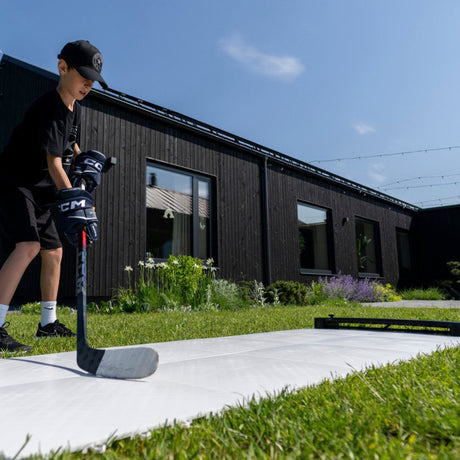
This is where ball-and-wall training transfers to on-ice skill. Set up a shooting pad and have a partner shoot or roll pucks toward you from 4–6 metres.
- Basic tip drill: Partner rolls pucks slowly. Tip each puck into a specific zone with the blade. Focus on watching the puck all the way onto the blade. 3 × 10 pucks.
- Speed tip: Partner fires pucks at moderate speed. Tip into high or low zone called out by partner just before the puck is released. 3 × 10.
- Blade-angle variation: Tip pucks to alternate sides — forehand tip, then backhand tip. Alternate without warning. 4 × 8 pucks.
- Moving tip: Move laterally 1–2 steps before each puck arrives. Simulates the net-front positioning change between shots. 3 × 8.
Watch for: eyes closing or flinching at puck release. This is the single most common hand-eye error in tip drills. Fix: start at slower speeds and build. Flinching means the drill is too fast for the current skill level.
Coach Erik's tip: The tip is really about predicting where the puck will cross your blade, not reacting to it after it arrives. That prediction is built by watching a partner's shot motion from the release point — not watching the puck mid-flight. Cue your players to "watch the blade, not the puck" for the first third of its travel. The tracking habit forms within a few sessions.
Game Changer iPuck reactive training
The Game Changer iPuck turns hand-eye training into a game: the light embedded in the puck illuminates targets on the board in random sequence, and you must react and redirect before the next light fires. This is the highest-specificity hand-eye drill short of live game play, because it combines puck handling, unpredictable visual stimuli, and time pressure in one rep.
Use it for the last 5 minutes of every session as a finisher. The competitive format (score tracked automatically) keeps intensity high. For structured game formats that build awareness alongside hand-eye skill, explore the full Game Changer system.
Weekly training plan
| Day | Drill focus | Duration | Volume |
|---|---|---|---|
| Monday | Juggling progression + wall catches | 15 min | 3 sets each |
| Tuesday | Stickhandling ball reaction + iPuck games | 15 min | 3 sets + 5 min game |
| Wednesday | Rest or light stickhandling | — | — |
| Thursday | Deflection drills on shooting pad | 20 min | 4 sets, 8–10 pucks |
| Friday | Full combination session (juggle → wall → deflect → iPuck) | 25 min | 2 sets each |
| Saturday | Reaction catches + game application | 15 min | 3 sets |
| Sunday | Rest | — | — |
Common mistakes
- Watching your hands instead of the target. Juggling while looking at your hands trains the wrong habit. Fix: fix your gaze at eye level or above — the hands work below your line of sight.
- Starting too fast. Throwing too hard before the pattern is grooved leads to compensation, not improvement. Fix: master 3 × 20 slow wall catches before adding speed or distance.
- Only training one hand. Hockey demands both hands equally — the top hand in a puck battle, the bottom hand in a tip. Fix: always train both hands, and note which is weaker so you can add reps on that side.
- Inconsistent sessions. A single long session once a week is far less effective than 10 minutes daily. Fix: pair hand-eye drills with an existing habit — before skating, after stickhandling warm-up.
- No progression tracking. Without measuring, you can't know if you're improving. Fix: log juggling duration and wall-catch drop rate each session. Even a simple tally on your phone is enough.
FAQ
Does juggling actually improve hockey hand-eye coordination?
Yes — research on ball sports consistently shows that juggling training improves hand-eye reaction speed and dual-task motor control. For hockey, the most relevant benefit is bilateral tracking of unpredictable objects, which transfers directly to tips, deflections, and loose puck situations. Start with two balls and build the habit before worrying about three.
How long does it take to improve hand-eye coordination in hockey?
With 4–5 sessions per week of 10–15 minutes, most players notice quicker reactions on tips and wall pucks within 3–4 weeks. Full transfer to game speed — where reactions feel instinctive — typically takes 6–8 weeks of consistent training.
What is the best hand-eye coordination drill for hockey?
The stickhandling ball off a wall with cross-body catches is the highest-value single drill because it is fast, unpredictable, and requires both hands asymmetrically — the same demand as a board battle or deflection. Pair it with the Game Changer iPuck for hockey-specific stimulus-response training.
Can kids train hand-eye coordination for hockey?
Yes — children aged 7 and up respond very well to juggling and wall-catch progressions. Use a softer ball for younger players (under 10) to reduce flinching. The neural adaptations happen faster in young athletes, so starting early builds a foundation that pays off through the teenage years.
How does hand-eye coordination relate to reaction speed in hockey?
They are closely linked: reaction speed is the time from seeing a stimulus to starting a movement; hand-eye coordination is the accuracy of the movement that follows. Training both together — with drills that are unpredictable but require a precise response — is more effective than training either in isolation. See the sibling guide on hockey reaction speed training for the reaction-specific side of this.
Is a shooting pad needed for deflection drills?
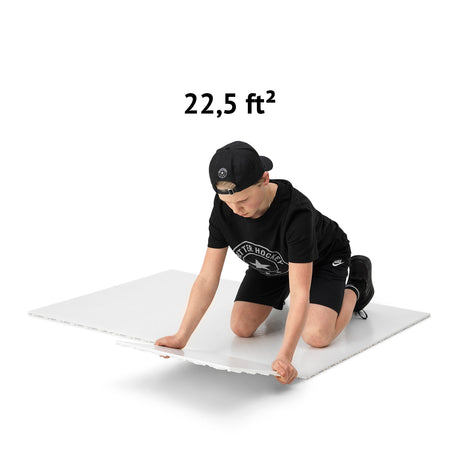
A shooting pad is strongly recommended because it gives pucks consistent glide and protects your stick blade. Without a pad, pucks bounce unpredictably off concrete or carpet, which adds noise to the drill rather than building the specific tip-reaction skill. A 24"×48" pad is large enough for all the deflection drills listed above.
Summary
Hand-eye coordination training for hockey follows a clear progression: juggling two balls builds the bilateral tracking foundation, wall-catch drills with a stickhandling ball accelerate reaction speed, deflection reps on a shooting pad transfer it to hockey-specific skill, and Game Changer iPuck games train the full stimulus-response loop at game intensity. Run 4–5 sessions per week, 10–20 minutes each, and track your drop rate and reaction accuracy from session to session.
For more drills that build puck skill alongside hand-eye training, see the best hockey stickhandling drills guide. For the reaction speed component, read the full hockey reaction speed training guide.