Quick answer
A saucer pass lifts the puck off the ice, flies flat through the air, and lands blade-down for the receiver to handle — it clears sticks and skates that a flat pass can't. The technique has three parts: an aggressive heel-to-toe blade path that rolls the puck off the toe with backspin, a wrist rotation that tilts the puck face-up at release, and a controlled flat landing aimed at the receiver's forehand. Beginners can learn the basic motion in one 20-minute session; consistent, catchable sauce takes 2–4 weeks of deliberate repetition.
Key takeaways
- The saucer pass is three movements combined: blade path (heel to toe), wrist roll (tilts puck face-up), and follow-through (controls height and landing angle).
- Backspin is what makes the puck land flat — not luck. If your sauce tumbles, you're not rolling it off the toe correctly.
- Practice landing first, not loft. A low sauce that arrives catchable beats a beautiful arc that bounces.
- Distance range: 8–20 feet for most game situations. Beyond 25 feet, the puck loses spin and tumbles on landing — work on shorter, catchable passes before chasing distance.
- The Sauce Combo is the best two-player sauce training tool available — it turns distance accuracy into a measurable score game, which accelerates learning faster than open-ice sauce practice.
- Adult beginners and youth players over age 10 learn sauce equally fast — it's a technique skill, not a strength skill.
Saucer pass technique: the three-part breakdown
Most players try to "scoop" the puck into the air. That produces a tumbling, uncatchable pass. The real saucer pass is a rolling motion — the same heel-to-toe mechanics as a wrist shot, with the blade tilted back to add lift and spin.
Part 1: Blade path
The puck starts on the heel of the blade and rolls to the toe — identical to a wrist shot. The blade doesn't scoop under the puck; it sweeps through it on a slightly tilted face. The heel-to-toe roll is what generates the backspin that stabilizes the puck in flight.
Cue: "Wrist shot mechanics, blade tilted back 15 degrees." If your sauce tumbles, you're either skipping the roll (starting mid-blade or at the toe) or you're scooping instead of rolling.
Part 2: Wrist rotation at release
As the puck reaches the toe, both wrists roll: the bottom hand supinates (palm turns up) while the top hand follows through. This tilts the puck face-up so it flies like a frisbee — flat, spinning, stable. The amount of wrist roll controls the height: more roll = more loft, less roll = lower, faster sauce.
Watch for: the bottom elbow dropping before the roll. If the elbow drops early, the blade flattens and you get a flat pass with a slight hop, not a true sauce. Keep the elbow up through release.
Part 3: Follow-through and landing control
Point the toe of the blade at your target, same as a wrist shot follow-through. The angle of your blade at release controls where the puck lands relative to the receiver: blade face pointing slightly down brings the pass to ice level; blade face level brings it to knee height. For a catchable pass, aim to land it tape-to-tape at shin level — receiver handles it on the forehand without reaching up or down.
Coach Erik's tip: The most common sauce error I see is releasing too early — the puck leaves from the middle of the blade, not the toe. Put a strip of tape on your blade at the toe and another at the heel. When you practice, you should feel the puck traveling from the heel tape to the toe tape before it leaves. If you're releasing from the middle, the puck gets no spin and no height.
Saucer pass progression drills
Work through these in order. Each drill has a standard — meet it before moving on.
| Drill | Distance | Reps | Focus | Standard |
|---|---|---|---|---|
| 1. Slow-motion roll-off | 3 feet into air | 3 × 10 | Heel-to-toe roll only, no loft concern | Puck rolls cleanly off toe every rep |
| 2. Low sauce to the floor | 6 ft | 3 × 10 | 1–2 inch loft, flat landing | 8 of 10 land flat (no bounce) |
| 3. Shin-height sauce to partner | 10 ft | 3 × 15 | Catchable height, receiver forehand | 12 of 15 catchable without reaching |
| 4. Over-a-stick sauce | 10 ft | 3 × 15 | Clear a stick laid flat on the ground | 13 of 15 clear the stick, land catchable |
| 5. Distance accuracy — Sauce Combo | 15–20 ft | 3 × 15 | Land in the sauce catcher pocket | 8 of 15 in the pocket at 15 ft |
| 6. Moving sauce — pass to a walking receiver | 12 ft | 3 × 10 | Lead the receiver, land at shin height | 7 of 10 land within one step of receiver |
Drill 4 is the constraint that fixes the most technique errors fastest: placing a stick flat on the ground between you and your partner gives the puck a real obstacle to clear, forcing correct loft without overcomplicating the cue.
Sauce games with the Sauce Combo

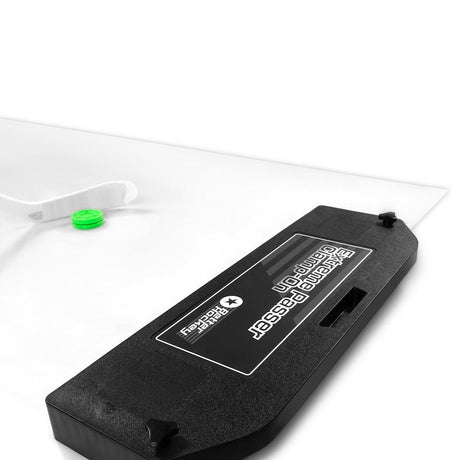
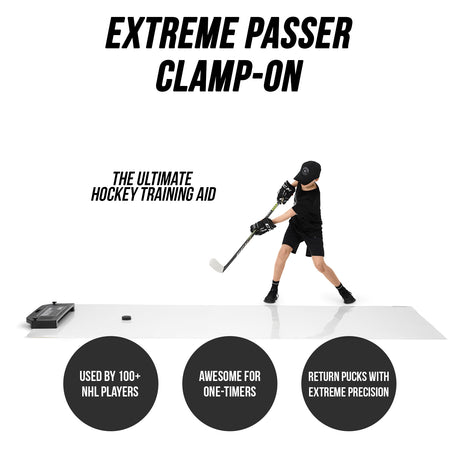
Open-ice sauce practice — just flipping pucks back and forth — improves slowly because there's no measurable target and no consequence for a bad pass. The Sauce Combo Single and Sauce Combo Double solve this by giving every pass a defined target: the sauce catcher pocket, which holds pucks and scores hits.
The game format that produces the fastest learning:
- 5 warm-up passes from 10 feet. No score — just feel the distance and the landing zone.
- 10 scored passes from 12 feet. Count how many land in the pocket.
- Move back 3 feet. 10 passes from 15 feet. Count again.
- Best of 10 competition. Two players alternate 10 passes each from 15 feet. Highest pocket score wins.
- One-touch challenge. Receiver must pass back immediately after the puck lands, before it stops moving. Forces quick hands and pushes the receiver's technique.
The Sauce Launch Pad pairs with the catcher to give the puck a smooth glide surface at launch — particularly useful in driveways where concrete texture affects the blade path at the start of the roll.
Accuracy standards by skill level
| Skill level | Distance | Accuracy target | Time frame to reach |
|---|---|---|---|
| Complete beginner | 6 ft | 6 of 10 flat landings | Week 1 |
| Beginner | 10 ft | 8 of 10 catchable at shin height | Weeks 2–3 |
| Intermediate | 15 ft | 7 of 10 in sauce catcher pocket | Month 2 |
| Intermediate | 20 ft | 6 of 10 in pocket | Month 2–3 |
| Advanced | 20 ft, moving receiver | 8 of 10 within one stride of receiver | Month 3+ |
| Advanced | 25 ft | 5 of 10 in pocket, flat landing | Month 4+ |
Coach Erik's tip: Don't chase distance early. I see players trying 20-foot saucers in week one and wondering why nothing catches. Get your 10-foot sauce consistently catchable first — that's the pass that wins games anyway. Most in-game sauce situations are 8–15 feet, clearing a single stick or skate. Master that range, then extend.
When to use a saucer pass in a game
The saucer pass isn't a trick play — it's a specific tool for specific situations. Use it when:
- A flat pass is blocked by a defender's stick or skate and there's clear space above.
- You're in the slot and need to hit a teammate at the far post without a defender intercepting at ice level.
- On the power play, to hit the half-wall or back door when the penalty killers are collapsing low.
- Breakout from behind the net — saucing to a winger at the boards clears the D's stick in the lane.
Don't use it when a flat pass works fine. A sauce that misses is a turnover. The saucer pass earns its place in your game only when the flat pass is genuinely blocked.
For all other passing fundamentals — accuracy, receiving, and one-touch passing — see the hockey passing accuracy drills guide. The one-touch passing guide covers the next skill that pairs directly with sauce development.
Common mistakes
- Scooping instead of rolling. Scooping produces a tumbling puck with no backspin. Fix: consciously feel the heel-to-toe roll before the release. Slow it down to half speed until the roll is automatic.
- Releasing from the middle of the blade. Early release kills both height and spin. Fix: use the tape-mark drill — tape at the heel and toe, feel the full blade path on every rep.
- Bottom elbow drops before release. Flattens the blade and removes the loft. Fix: keep the bottom elbow elevated through the wrist roll, like you're pouring from a cup.
- Too much loft, no accuracy. Chasing height loses directional control. Fix: aim for shin-height landings; height comes naturally once the roll is correct.
- Practicing at too great a distance too soon. Long sauce with poor mechanics bakes in bad habits. Fix: master 10-foot sauce before adding distance. Move back only when 8 of 10 are catchable at the current distance.
- Never practicing the receive. A sauce you can't catch cleanly breaks down in a game. Fix: equal time passing and receiving in every sauce session — the receiver trains one-touch handling as the passer trains technique.
FAQ
How hard is it to learn a saucer pass?
The basic mechanics — getting the puck airborne and landing reasonably flat — can be learned in one 20-minute session for most players. Getting it consistently catchable at 15 feet takes 2–4 weeks of daily practice. Making it a reliable in-game weapon where you can sauce under pressure, to a moving target, takes a full off-season of deliberate repetition.
What makes a saucer pass different from a regular pass?
A regular pass slides along the ice. A saucer pass lifts 1–6 inches off the ice, flies through the air spinning flat, and lands blade-catchable. The backspin stabilizes it in flight so it doesn't tumble — that's the key technical difference. Without backspin, it's just a wobbly airborne puck, not a true saucer.
Can I practice saucer passes alone?
Yes — use the floor as your target. Aim to land the puck flat on a specific floor tile or mark from 6–10 feet. This trains the landing accuracy component of sauce without a partner. For a target that catches and returns pucks, the sauce catcher makes solo practice measurable and far more productive.
What age can kids start learning the saucer pass?
Most players are ready to learn the basic motion from age 10–11, when the wrist strength and coordination for a clean heel-to-toe roll is generally in place. Younger kids can try it but shouldn't be pushed — a flat pass mastered is more valuable than a sauce attempted too early. Introduce it as a fun bonus skill once flat passing is reliable.
How do I stop my saucer pass from tumbling?
Tumbling means no backspin, which means the puck left the blade from the middle or you scooped instead of rolled. Slow down to half-speed: feel the heel-to-toe roll all the way to the toe, then the wrist supination (palm turning up) at the end. The tumble disappears as soon as the full blade roll and wrist rotation happen correctly together.
What is the best drill for saucer pass accuracy?
The over-a-stick drill (clearing a stick laid flat on the ground between two players at 10 feet) is the single most efficient accuracy drill for beginners — it forces correct loft with an immediate consequence. For intermediate players, the Sauce Combo Double with scored passes gives the fastest accuracy improvement because every attempt has a measurable result.
Summary
The saucer pass is three mechanics — heel-to-toe blade roll, wrist supination at the toe, and follow-through pointing at the target — producing a backspin-stabilized pass that clears sticks and skates a flat pass can't. Master the short game (6–10 feet) before extending distance. Use a sauce catcher to make every practice rep measurable. Add the pass to your game only in situations where the flat pass is genuinely blocked — executed at the right time, it's one of the most effective plays in the game.
Continue your passing development: the passing accuracy drills guide for flat-pass fundamentals, the one-touch passing guide for the next progression, and browse all Sauce products to set up your training setup at home.